To be Muslim in America is to live between two different worlds where you’re often pulled in opposite directions, and sometimes, you find yourself suspended in silence due to feeling overwhelmed. Being Muslim in the West is to carry a sacred tradition that traces its roots back to divine revelation while simultaneously navigating a society that is built on pluralism, hyper-individualism, and shifting morality. It is to explain your beliefs in classrooms, defend your practices in workplaces, and assert your humanity in headlines (on an almost daily basis). It is, in a very real sense, to wake up every day with the quiet but constant pressure to answer a looming question, “why are you still a Muslim?” Yet, despite the incessant pressure that Muslims in the West face, or perhaps because of it, millions of Muslims across the United States continue to pray, fast, raise their children on The Quran, build masajid, and spread the truth of Islam in one of the most ideologically complex societies in the world.
These experiences, however, aren’t to be treated as survival stories. This is what it looks like when faith is forged, not in the comfort of cultural majority or institutional protection, but in the friction of daily life, in boardrooms and dorm rooms, at PTA meetings and, especially, TSA checkpoints. This is what it looks like when imaan is not inherited, but chosen again and again. Being Muslim in America has taught us something profound, and that is that Islam is not weakened in foreign lands, it is actually purified tenfold. It has taught us that dawah does not need ideal conditions to thrive, it needs sincere hearts, and that Allah’s (SWT) promise to preserve His light is not tied to geography, but to the will of believers to carry it.
This article is a deep dive into our lived reality as Muslims in the United States, and into the truths it reveals about our faith, our future, and our responsibility to convey the message of Islam to a world that is aching for meaning, and answers to its biggest questions.
The paradox of Muslims in America—the test of faith in a land of freedom and confusion
America, in many ways, offers Muslims something rare, and that is the legal freedom to practice and preach our religion without direct state interference. There are no bans on hijab in schools, no government raids on masajid for holding nightly prayers, and no official suppression of Islamic holidays. The Constitution’s First Amendment provides Muslims, as well as other religious communities, the right to worship freely, to establish institutions, and to engage in dawah openly. However, spiritual tests do not always come in the form of bans and bullets. Sometimes, they come in the form of freedom itself.
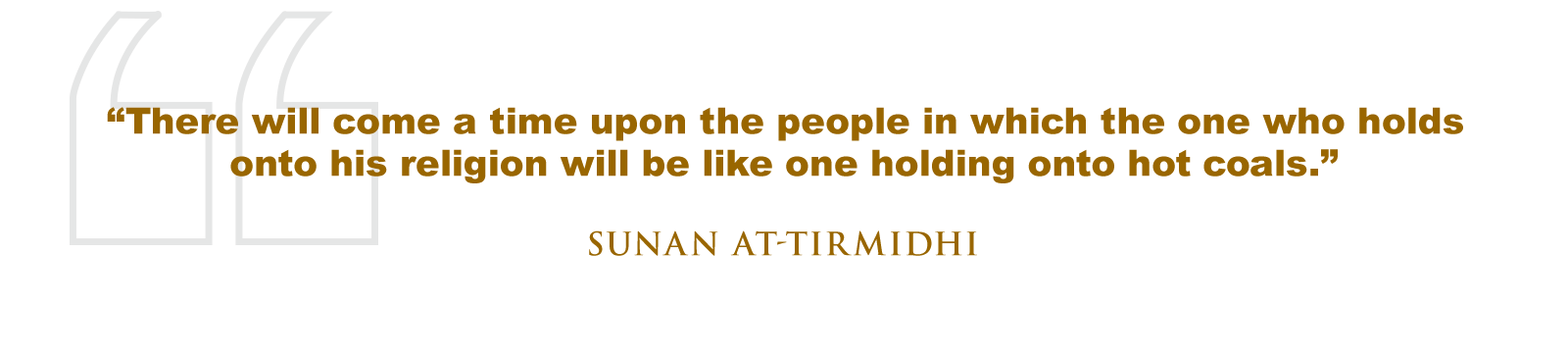
The American social climate, while outwardly pluralistic, is saturated with ideologies that subtly, and sometimes openly, erode the foundations of Islamic faith such as moral relativism, materialism, hypersexualization, and a persistent pressure to privatize religion in the name of secularism. Young Muslims are not jailed for their belief in tawheed, they are simply asked to “keep it to themselves.” Muslims are not exiled for praying salaah, they are just told not to “disrupt the workflow.” This quiet form of spiritual erosion is what the Prophet (SAW) warned us about when he said, “There will come a time upon the people in which the one who holds onto his religion will be like one holding onto hot coals.” (Sunan at-Tirmidhi)
Yet, amidst this climate, American Muslims are demonstrating a resilience that cannot be explained by cultural legacy alone.
According to the Pew Research Center, “Muslims make up only about 1% of the adult population in the United States,” and in a recent 2023-2024 research study, 36,000 respondents to their Religious Landscape Study (RLS) were able to provide an enlightening glimpse into the diversity of thought and practice within the U.S. Muslim population (something that has not yet been done before). Unique findings within the diversity of American Muslims include that some are very religious, and others struggle in their faith or it is not that important in their lives (this is similar to American Christian populations); whilst there are many Muslims who have migrated from overseas, there is no ethnicity that dominates this population; a third of Muslims American adults are under the age of 30 which makes this group of people, on average, younger than the American adult population (How U.S. Muslims compare with other Americans religiously and demographically, 2025).

Amongst U.S. adults, 38% say that religion is very important. Of that 38%, 55% of Christians say that their religion is very important; however, Muslims score higher on the scale where 60% say that their religion is important to them. Further, 93% of Muslims say they believe in God or a higher power, and this includes 72% of Muslims having a firm belief that God truly does exist. Approximately 25% of U.S. adults say that they attend religious services at least once a week, and 39% of Muslims attend religious services at least once a week. This study further highlighted that “roughly 30% [of Muslims] are White, 30% are Asian, 20% are Black, 11% are Hispanic and 8% either identify with a different race or more than one racial group.”
Finally, as compared to Christians in America, a great number of Muslim Americans have populated the academic arena where 44% of adult Muslims are either graduates, and of that 44%, 26% have either a masters or doctoral degree (14% of Christians and 16% of non religiously affiliated people have advanced degrees). Such a strong presence in academia could largely be due to the fact that the average age of Muslim Americans, currently, is under 30.
What these numbers show us and why they matter is because not only is Islam surviving in America, but it is holding firm even among the young and newly converted Muslims, and this is no accident. This reminds us of a powerful statement from the Prophet (SAW) where he says, “Islam began as something strange and will return to being strange, so give glad tidings to the strangers.” (Sahih Muslim)
In the American context, these “strangers” are not just converts or minorities, they are those who refuse to let go of the rope of Allah (SWT) when society tells them to drop it. They are the high schoolers fasting through lunch period and sometimes gym classes, the young professionals praying in storage rooms during work hours, the women explaining hijab for the hundredth time, or the men attending Jumu’ah on their only day off. They might be strangers in the land of diversity, but they are steadfast.
How to live impactfully as a minority—lessons from the sirah of our Prophet (SAW)
It’s easy to forget that Islam was established in the margins of society. It was not a religion that was immediately accepted, nor implemented within the cities of Makkah and Madinah until many treaties were signed, armies were formed, and even battles were fought. Islam was a call, nothing more and nothing less in the beginning. A call to worship Allah (SWT). A call to truth and justice. A call to reform the soul and society at large, and this call was made by individuals who had no worldly power, only conviction.
Bilal ibn Rabah (RA) was chained and tortured in the desert for uttering, “Ahadun Ahad.” The family of Yasir was martyred in the streets. The Prophet (SAW) himself was mocked, slandered, and nearly assassinated yet he never compromised the essence of his message which was to always remain firm on the path of Allah (SWT). We treat this as history, but actually, this is the perfect blueprint for us. When Muslims live as minorities in the West, we are reminded that our strength never came from numbers, safety, or political dominance. Our strength has always come from sabr, tawakkul, and a clear commitment to dawah even if it may be costly.
Allah (SWT) says, “So endure patiently, as did the Messengers of Firm Resolve. And do not seek to hasten the torment for the deniers. On the Day they see what they have been threatened with, it will be as if they had only stayed in this world for an hour of a day.” (The Clear Quran®, 46:35)
Living in America requires the same kind of prophetic patience. Muslims here are called to represent Islam not with coercion or superiority, but through moral clarity, personal integrity, and unwavering commitment, even when misunderstood, sidelined, or targeted.
One of the most profound moments in early Islamic history is the Hijrah to al-Habasha when a group of Muslims fled persecution in Makkah and sought refuge under the Christian king, al-Najashi. This was the first Muslim minority in a non-Muslim land. The Muslims were grateful for the protection they received, but they didn’t hide their identity to “blend in.” When al-Najashi summoned them to explain their beliefs, Ja’far ibn Abi Talib (RA) stood before the king and delivered what remains one of the earliest and most powerful acts of interfaith dawah in Islamic history. He said, “O King, we were a people steeped in ignorance, worshipping idols… until Allah sent us a messenger. He commanded us to speak the truth, to fulfill trusts, to maintain family ties, to honor our neighbors, and to refrain from unlawful bloodshed… so we believed in him and followed him. And for this, our people turned against us.” This bold, eloquent defense of Islam was not just tolerated, it won the respect of a Christian king. He saw the truth in it and famously said, “What you have said and what Isa brought come from the same light.”
What lesson does this hold for American Muslims? That even in non-Muslim lands, our values can resonate with others, if we know our faith well enough to articulate it with honesty and conviction. Ja’far ibn Abu Talib (RA) didn’t dilute Islam to make it palatable. Nor did he antagonize. He presented Islam as it is, and that was enough.
The sirah also teaches us that living in a non-Muslim society is not inherently a weakness. It is, in fact, an opportunity if approached with clarity, confidence, and connection to Allah (SWT). In the Treaty of Hudaybiyah, for example, the Prophet (SAW) accepted terms that seemed unfavorable at first, but ultimately opened the doors to dawah and led to the peaceful spread of Islam. He built relationships even with those who opposed him. He protected the unity of the Muslims while strategically planning for the future. Likewise, Muslims in America are not here by accident. Whether born here, converted here, or migrated here, Allah (SWT) has placed each of us in this land for a reason.
Allah (SWT) says in The Quran, “Fighting has been made obligatory upon you believers, though you dislike it. Perhaps you dislike something which is good for you and like something which is bad for you. Allah knows and you do not know.” (The Clear Quran®, 2:216)
Being a minority can feel isolating, but the Seerah teaches us that Islam has flourished, not only in empires, but in exile, in migration and in minority spaces. It teaches us that numbers don’t determine impact, sincerity does.
Islam without culture is a double-edged sword
In many parts of the world, Islam is woven into society’s culture. Friday prayers are a societal norm. Ramadan shapes business hours. Quran recitation is the sound of the streets. Being Muslim is not just a personal choice, it’s an expectation, a norm, a default. However, in America Muslims often experience something dramatically different. Islam is stripped of its cultural scaffolding. The comfort of shared rituals, the reinforcement of Muslim norms in public spaces, even the assumed modesty of the surrounding environment, all of that disappears. At first, this feels like loss, however, when we look deeper, we discover that this vacuum also creates an unexpected opportunity, Islam becomes clearer, purer and more deliberate, if we are willing to reclaim it.
However, this is a gift in this cultural vacuum. Islam, at its heart, is not tied to any ethnicity, language, or dress code. It is a universal faith timeless, adaptable, and meant for every person in every place, and in America, many Muslims are rediscovering this for the first time. Take, for example, the growing number of American converts. For example, a Pew Research Center report states that 20% of U.S. Muslims are converts (Islam: Switching into and out of religion in 13 countries, 2025) There Islam isn’t inherited, it’s sought out. They often come with few cultural expectations and ask deep questions. They seek evidence. They learn from scratch, and in doing so, they often see the core of Islam more clearly than those who were raised within its traditions.
This is not to romanticize the convert experience, which comes with its own profound hardships, especially due to lack of support, but it is to recognize that a stripped-down Islam can also be a clarified Islam. Many young Muslims in America are now reclaiming their religion not as a cultural obligation, but as a chosen truth. They’re learning Arabic to access The Quran. They’re studying fiqh and seerah. They’re starting Quran study circles, launching Muslim podcasts, filling MSAs, and attending Islamic Studies classes.
This is exactly what our Prophet (SAW) would have wanted.
The burden and blessing of representation
Whether you’re a Muslim woman wearing hijab on the subway, a student named Muhammad on the first day of class, or a man stepping aside to pray dhuhr at work, you’ve likely experienced this moment, and that is the realization that you’re not just representing yourself, you’re representing Islam. Your religion which is the religion of our Prophet (SAW), gifted by Allah (SWT) Himself. Every action of yours becomes a statement, every word a symbol, every mistake a reflection, not just of you, but of 1.9 billion people around the world. While this can feel suffocating, it is also one of the most profound ways Allah (SWT) dignifies the believer in non-Muslim lands. To carry the name of Islam in a place where it’s often misrepresented is not just a test, it’s an amanah.
Many people in the West have never even had an interaction with a Muslim. Their image of Islam is mainly shaped by media headlines, political rhetoric, and pop culture stereotypes. This means that for many people, you are Islam. The way you carry yourself, the way you speak, and even the way you respond to pressure, all of it becomes part of someone’s mental file labeled as “Muslim.” While generalization is truly an unfair burden to deal with, it is also the perfect dawah opportunity that cannot be manufactured in books or lectures. Your simple presence in classrooms, hospitals, offices, grocery stores, and sports teams is shaping hearts, often silently.
Allah (SWT) says, “Surely those who say, ‘Our Lord is Allah,’ and then remain steadfast, the angels descend upon them, saying, ‘Do not fear, nor grieve. Rather, rejoice in the good news of Paradise, which you have been promised.’” (The Clear Quran®, 41:30)
To remain visibly Muslim in a society that either ignores or vilifies your faith, this is a kind of istiqamah that transforms dawah from speech into presence.
In a hyper-connected world, your smallest actions can go viral for better or worse. A Muslim youth posting a heartfelt dua or a Quran recitation on TikTok might inspire thousands. A visible act of kindness from a Muslim charity volunteer might change someone’s perspective for life. A Muslim Uber driver explaining Ramadan to a passenger can spark questions that turn into guidance. At the same time, an angry outburst, an online argument, or an offhand comment can reinforce stereotypes in a second. It is both empowering and terrifying that we are always being watched.
Allah (SWT) says, “Let there be a group among you who call others to goodness, encourage what is good, and forbid what is evil, it is they who will be successful.” (The Clear Quran®, 3:104) This verse is often cited in the context of dawah, yes, but in America, every Muslim is part of that group by default. You may never hold a microphone or stand on a stage, but your everyday presence in a non-Muslim environment is a kind of dawah, especially when rooted in sincerity, humility, and akhlaaq.
Above all else, look at the notable American Muslim figures we have today such as Mehdi Hasan, Linda Sarsour, Omar Suleiman, Yara Shahidi, Zohran Mamdani, and many, many others—Muslims are no longer invisible in America, and that visibility brings both risk and responsibility to us. Muslims are making strides in the entertainment industry; Muslim athletes unabashedly show their faith on the field; Muslim academics and activists are shaping discourse; Muslim hijabis are featured in fashion campaigns and ad spaces. On the one hand, this visibility allows for normalization. Islam is no longer a strange, foreign concept.
However, on the other hand, visibility can come at the cost of compromise. Some public Muslims feel the pressure to soften Islamic principles, avoid “controversial” beliefs, or downplay worship in order to stay accepted in secular spaces. The result is a subtle distortion that Islam becomes aesthetic, inspirational or spiritual but no longer demanding, structured or Divine. We must resist this. We cannot afford to build a generation of public Muslims who are known for being Muslim, but not for conveying what Islam actually is. Allah (SWT) says, “And whose words are better than someone who calls others to Allah, does good, and says, ‘I am truly one of those who submit?’” (The Clear Quran®, 41:33)
When non-Muslims see a Muslim who is anchored, who prays five times a day, who lowers their gaze, who honors their parents, who raises children with purpose, who serves the community without seeking clout, they notice. Some of them come forward and ask questions, they learn, and some of them feel so enlightened that they end up embracing Islam. However, this only happens if we show it in its truest and purest form.
Dawah is not optional
For Muslims in America, dawah is often treated like a choice. It’s a good deed for the few rather than a shared obligation for the many. We think of dawah as something that is too “out there” when we see street preachers handing out flyers, or famous YouTubers giving debates. While those forms matter, yes, they represent only a fraction of what dawah truly is. The reality, and it’s time we say this clearly, is that dawah is not optional. It is not an accessory to our imaan, is the evidence of our imaan. The command to call others to Allah (SWT) is not addressed only to prophets, scholars, or imams, it is addressed to the ummah as a whole. Every Muslim who knows even a single verse from The Quran.
Allah (SWT) says, “Let there be a group among you who call others to goodness, encourage what is good, and forbid what is evil—it is they who will be successful.” (The Clear Quran®, 3:104)
The command here is not limited to formal platforms. It applies to everyday life: conversations with coworkers, your online presence, your speech in family gatherings, your conduct in school or business. Dawah is the conscious effort to connect others to Allah (SWT) sometimes with words, but more often through example.
More powerfully, Allah (SWT) describes the best possible speech as belonging to the one who does dawah. “And whose words are better than someone who calls others to Allah, does good, and says, ‘I am truly one those who submit?’” (The Clear Quran®, 41:33)
We are living in a time where falsehood is broadcasted louder, slicker, and faster than ever before. Misguided ideologies are promoted as liberation. Moral confusion is packaged as compassion. Spiritual emptiness is normalized as freedom. Yet, amid all this noise, people are searching.
They are trying to make sense of suffering. They are aching for peace of heart. They are bringing out from chasing the world, and they are noticing, even if only subconsciously, that Muslims are different. However, if we don’t offer them clarity, others will offer them confusion. If we don’t introduce them to Islam, they may never hear the truth not because it wasn’t available, but because we withheld it. This isn’t just about converting others, that’s in the hands of Allah (SWT). This is about clearing the path, removing misconceptions, and opening a door so that when someone is ready, Islam is waiting, unfiltered and untouched.
Allah (SWT) says, “Whether We show you, O’ Prophet, some of what We threaten them with, or cause you to die before that, your duty is only to deliver the message. Judgment is for Us.” (The Clear Quran®, 13:40)
Dua
O Allah! Make us among those who call to You with insight, who act upon what they say, who give glad tidings of Your mercy, and who fear not the blame of any blamer in Your cause.
O Allah! Make us keys to goodness, locks against evil, light in the midst of darkness, and guides to Your straight path.
O Allah! Use us for Your religion and do not replace us. Make us among the grateful to You, the helpers of Your deen, the true followers of Your Messenger (SAW), and the strivers in Your path.
Ameen!