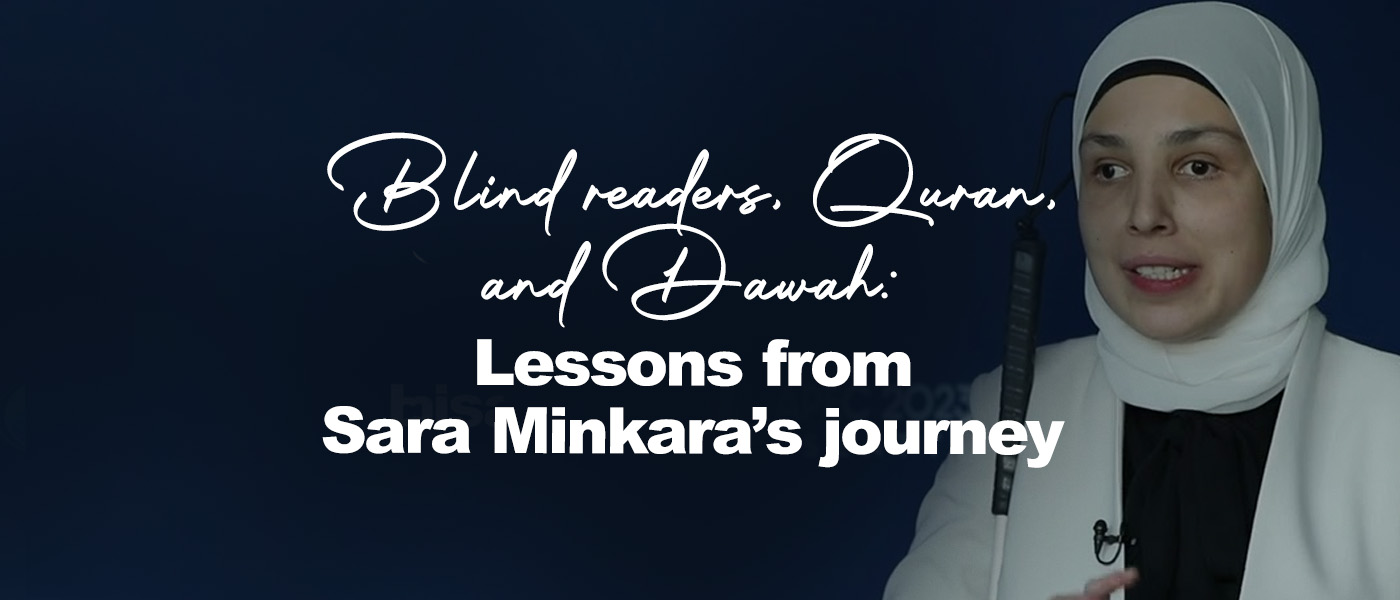
In many parts of the world, discussions about inclusion often begin only after exclusion has already become visible. For blind communities, this is especially true in the field of religious access where books, lectures, educational programs, and public religious life are often designed first for sighted audiences and only later adapted for others. Yet faith, by its nature, speaks to every human being equally, and the responsibility of making religious knowledge accessible belongs to the community itself. In this context, the work and public example of Sara Minkara has become especially significant, not only as a symbol of disability inclusion, but as a reminder that access to knowledge, dignity, and public participation must be treated as essential rather than optional. Sara Minkara, a Lebanese-American advocate who is blind since infancy, has emerged internationally as one of the strongest voices for disability rights, inclusive education, and equal participation in public life.
Her work has crossed educational, diplomatic, and policy spaces, including her service in international disability rights leadership, where she consistently emphasized that disability should never be understood through limitation alone, but through the removal of barriers created by society itself. Her public message has often centered on a simple but powerful idea that people are not excluded because of disability alone, they are excluded because systems are built without considering them. This principle carries deep relevance for Islamic dawah. For many blind Muslims around the world, access to Islamic knowledge remains limited not because interest is absent, but because materials are unavailable in formats they can use. Quran copies in Braille remain scarce in many regions, Islamic books are often inaccessible, and many dawah institutions still rely heavily on visual presentation without developing parallel systems for blind learners. In such a context, Braille becomes more than a reading tool, it becomes a means through which faith itself becomes reachable.
The connection between disability inclusion and dawah is not new in Islam. Islamic teaching repeatedly emphasizes that guidance is for all people, without distinction of physical condition, social status, or worldly ability. The Quran itself corrected attitudes of exclusion when Allah (SWT) revealed Surah ‘Abasa after a blind companion, Abdullah ibn Umm Maktum (ra), was overlooked during a moment of public teaching. That moment established an enduring principle that a person seeking knowledge must never be treated as secondary because of disability. Seen through that lens, Sara Minkara’s wider advocacy offers an important lesson for Muslim educational work today. Her example pushes institutions to ask whether accessibility is truly being treated as part of religious responsibility. If dawah aims to reach hearts, then its language, methods, and materials must also reach hands that read through touch rather than sight. Braille, audio learning, accessible teaching, and disability-conscious scholarship are not secondary additions to Islamic work, they are part of fulfilling its moral purpose.
Sara Minkara: From childhood blindness to global disability advocacy
Sara Minkara’s story begins long before her international recognition in disability rights and public leadership. Born in Lebanon, she lost her eyesight as an infant, entering life with a condition that would shape many of the social challenges she later chose to confront publicly. Yet blindness did not define the limits of her future; rather, it became part of the experience through which she learned very early how societies often treat disability not through ability itself, but through expectation. Growing up between Lebanese cultural roots and life in the United States, she encountered two very different environments, each carrying its own assumptions about blindness, education, and independence.
From childhood, one of the central realities she faced was that many everyday systems were built primarily for sighted people. Education, movement, reading materials, and social interaction often required adaptation not because learning was impossible, but because institutions were rarely designed with blind students in mind from the beginning. Like many blind children, success required learning not only school subjects, but also how to navigate environments that often assumed visual ability as the norm. These early experiences helped shape the perspective she would later carry into public advocacy that disability itself is often less limiting than the barriers created by society. Her academic journey reflected both discipline and determination. Sara Minkara later studied at Wellesley College, where she developed strong interests in economics, international development, and social policy. Her university years were important not only academically, but because they sharpened her understanding of how exclusion operates at institutional levels.
Rather than treating disability as a personal issue alone, she increasingly approached it as a structural issue, one that affects education, employment, leadership opportunities, and public participation across societies. After completing her studies, she began working in international development and disability inclusion, particularly focusing on the Middle East, where discussions about disability often remained limited by social stigma and inadequate institutional support. One of her most recognized achievements came through founding Empowerment Through Integration (ETI), an initiative designed to bring blind and sighted young people together through shared activities, leadership training, and direct social engagement. The purpose was not simply awareness, but changing attitudes through lived interaction. She understood that many barriers survive because people rarely experience inclusion in practical ways.
Her influence later expanded well beyond educational projects. Sara Minkara became internationally known in diplomatic and policy circles for advocating disability rights at a high level, eventually serving in major advisory and leadership roles connected to disability inclusion globally. In these spaces, she consistently emphasized that accessibility is not charity, it is justice. Whether discussing education, employment, technology, or public policy, her message remained clear that inclusion must be built into systems from the beginning, not added only after exclusion becomes visible. What makes her journey especially meaningful is that her accomplishments were never presented merely as personal triumphs over blindness. Instead, she repeatedly redirected attention toward wider questions such as: Why do blind people still struggle to access books? Why are educational materials unavailable in accessible formats? Why are leadership spaces still difficult to enter? These questions continue to shape her work today.
For Muslim communities, her example also opens an important discussion about religious accessibility. If inclusion matters in schools, governments, and public institutions, then it also matters in the way religious knowledge is shared. Blind Muslims often still face major barriers in accessing Islamic books, Quran copies, and structured religious education independently. In this sense, the wider principles Sara Minkara advocates naturally connect to one of the most neglected areas of modern dawah: accessibility through Braille.
Why the Braille Quran and Islamic literature matter in modern dawah
The question of Braille in Islamic dawah is not simply about technology or educational convenience, it concerns whether access to revelation is being made equally possible for all believers. For blind Muslims, reading is experienced through touch rather than sight, and because of this, Braille is not an alternative luxury but the primary path through which independent learning becomes possible. Without Braille access, many blind Muslims remain dependent on others for Quran recitation, religious study, and private engagement with Islamic texts. While audio recordings have expanded greatly in recent decades, listening does not serve identical purposes. Listening allows reception, but Braille allows personal study, repetition, memorization, reflection, and direct engagement with written language in a way that preserves intellectual independence.
This distinction becomes especially important in the case of The Quran. For sighted Muslims, the physical relationship with the written Quran carries both educational and spiritual meaning, and that is, one can return to verses repeatedly, compare passages, study tajweed markings, and develop familiarity with structure and placement. Blind Muslims deserve the same possibility through Braille Quran copies designed with precision and proper transcription. Yet in many countries, complete Quran sets in Braille remain difficult to obtain because they require multiple volumes, careful printing standards, and specialized production that many institutions have not prioritized sufficiently. The scarcity becomes even greater when one moves beyond The Quran itself into Islamic literature more broadly. Tafsir works, hadith collections, books of fiqh, dua compilations, and introductory dawah materials often remain unavailable in Braille across many Muslim communities. As a result, blind Muslims frequently encounter a second level of exclusion, and that is, even when basic Quranic access exists, deeper study remains restricted.
This affects not only personal religious growth but also leadership development, because scholars, teachers, and active community members emerge through sustained study, not through occasional access alone. From an Islamic perspective, making knowledge accessible is closely tied to the wider obligation of conveying beneficial knowledge. The Prophet Muhammad (SAW) said, “Whoever guides someone to goodness will have a reward like the one who does it.” (Sahih Muslim)
This hadith gives special meaning to accessibility work because producing Braille Islamic materials is itself a form of guiding toward goodness. Every verse read independently, every dua learned privately, and every Islamic concept understood directly through touch becomes part of an ongoing reward for those who made access possible. This is where the wider relevance of figures such as Sara Minkara becomes clear. Her advocacy has repeatedly challenged institutions to stop treating accessibility as a later adjustment and instead build it into the foundation of public work itself. For Islamic institutions, this means that Braille should not be viewed as a specialized project added only when resources allow; rather, it should be treated as part of responsible dawah planning from the beginning. A mosque that prints educational materials should ask whether blind readers can use it. A dawah organization distributing books should ask whether Braille copies exist. An Islamic publisher should ask whether digital accessibility and tactile formats are being considered before publication reaches the public.
Modern dawah increasingly speaks about reaching neglected populations, but blind Muslims and blind non-Muslims often remain among the least served in religious publishing. Braille therefore represents more than literacy, it represents equal invitation to faith, equal participation in worship, and equal dignity in seeking Allah’s (SWT) guidance.
Dawah in Braille: Making Islamic knowledge reach blind communities
One of the most important modern efforts in accessible Islamic outreach is Dawah in Braille, an initiative dedicated to making Islamic knowledge available to blind and visually impaired individuals through Braille materials, accessible resources, and direct educational support. Its work addresses a gap that has long existed in many Muslim communities. While Muslim books, Quran copies, and educational literature are widely distributed for sighted readers, blind Muslims and blind seekers of knowledge often remain underserved because those same materials are rarely produced in tactile formats. The importance of such work becomes clear when considering how blind readers engage with knowledge. Audio resources can provide listening access, but Braille offers something deeper, and that is independent reading, personal study, memorization, and direct interaction with written text. For many blind Muslims, reading Quranic verses through Braille allows a personal relationship with revelation that cannot be fully replaced by listening alone. It gives the reader privacy, repetition, and the ability to study carefully without relying entirely on another person’s voice.
Dawah in Braille therefore serves not only as a charitable project but as an educational responsibility. By producing Islamic texts in Braille and supporting access to religious learning, it helps ensure that blind individuals are not excluded from one of the most central dimensions of Muslim life, and that is, seeking knowledge. As a result, Dawah in Braille distributes its product, The Clear Quran® in Braille, to the following critical places:
- Masajid across North America to ensure there is always at least one complete box set available for the Blind musalli.
- Blind and visually impaired non-Muslims as an extension of our already robust Dawah program.
- Public libraries for access to all visitors.
- University and college campuses.
- Institutions for the blind and visually impaired.
For many English-speaking readers, The Clear Quran® translation by Dr. Mustafa Khattab is known as one of the easiest translations to read and understand because it presents Quranic meanings in clear, contemporary language without losing accuracy. Its wide benefit among Muslims and non-Muslims alike highlights an important accessibility gap, and that is, blind readers should also be able to engage with the same translation through Braille and other accessible formats. For $499, you can place the words of The Quran into the hands of someone who has never had the opportunity to read it through touch. What many readers can access easily on a shelf or screen remains unreachable for many blind individuals unless someone chooses to bridge that gap.
Changing perceptions of blindness in public life
One of Sara Minkara’s most important contributions has been the way her public presence challenged long-standing social assumptions about blindness itself. In many societies, especially where disability is still discussed cautiously or privately, blind individuals are often viewed through limitation before ability. Expectations are lowered early, and achievement is sometimes treated as exceptional simply because society did not imagine such participation in the first place. Sara Minkara’s visibility disrupted that pattern because she appeared not as someone asking merely for accommodation, but as someone actively shaping conversations in education, diplomacy, and leadership. This was particularly significant in Arab contexts, where public examples of blind women occupying visible leadership spaces have historically been limited. Representation matters because social attitudes often change only when people repeatedly witness what they previously assumed impossible. A blind woman speaking internationally, leading programs, advising institutions, and participating confidently in public dialogue carries influence beyond official titles. It changes how younger generations imagine what disability means.
Her work also helped shift language itself. Rather than presenting blindness through dependence, she consistently used the language of participation, contribution, and structural inclusion. This matters because the words societies use around disability often shape the opportunities that follow. When blindness is spoken of mainly as hardship, systems are built around protection. When it is spoken of as part of ordinary human diversity, systems begin moving toward accessibility and equal design. For many families raising blind children, examples like hers also carry practical importance. Public success stories can quietly reshape parental expectations, educational ambition, and social confidence. A child who sees that blindness does not prevent public achievement begins imagining a future differently. A family that once feared isolation begins thinking in terms of opportunity.
This wider social effect is often overlooked when discussing individual accomplishments. Sara Minkara’s influence is not limited to formal policy or advocacy projects alone, it also lies in how her life became evidence that blindness does not remove a person from leadership, intellect, or influence. In many ways, this cultural shift may prove just as important as any institutional achievement.
Changing systems, and changing expectations
Sara Minkara’s story is significant not simply because she succeeded despite blindness, but because she consistently transformed personal experience into public contribution. From her early childhood navigating a world largely designed for sighted people, to her later work in education, international advocacy, and leadership, her journey has reflected a broader principle and that is, true inclusion begins when societies stop treating accessibility as secondary and start treating it as part of human dignity itself. What makes her influence especially meaningful is that her work has reached beyond policy discussions into cultural imagination. She has helped challenge the idea that blindness belongs at the margins of public life, showing instead that disability and leadership are not opposites. In doing so, she has contributed to changing how blindness is understood by institutions, families, and younger generations who increasingly see possibilities where earlier generations often saw limitations.
Her example also raises an important question for communities concerned with knowledge, education, and moral responsibility. If inclusion is now recognized as essential in schools, workplaces, and public institutions, then it must also be taken seriously wherever learning is shared more broadly. Accessibility cannot remain an afterthought where human development is concerned. Ultimately, Sara Minkara’s public life reminds us that barriers are often maintained less by disability itself than by the failure to imagine participation fully. Once that imagination changes, institutions begin to change as well. And when institutions change, inclusion becomes something deeper than policy, it becomes part of how dignity is lived in everyday life.
Dua
O Allah (SWT)! Grant ease, strength, and continued blessings to all those who strive to remove barriers from the lives of others. O Allah (SWT)! Bless every sincere effort that opens doors of dignity, knowledge, and opportunity for those living with disability.
O Allah (SWT)! Increase beneficial knowledge, make learning accessible to every seeker, and place compassion, justice, and understanding in the hearts of communities everywhere.
O Allah (SWT)! Strengthen those who face hardship with patience, honor their efforts, and make their journeys a source of inspiration and reward. O Allah (SW)! Allow every work done for inclusion and human dignity to become a means of goodness in this life and a source of mercy in the Hereafter.
Ameen!