One of the most often overlooked, but deeply relevant, concepts in Islamic moral theology is the notion of collective sin, or what happens when transgressions are committed so widely and so systematically that they are no longer confined to the sphere of individual accountability. While Islamic law is clear on the principle that every soul bears responsibility for its own deeds, there remains a significant body of Quranic verses, Prophetic teachings, and scholarly commentary suggesting that societies, as moral entities, can also fall under divine judgment when wrongdoing becomes entrenched, normalized, or goes unchallenged by the broader community.
This leads to a profound and sometimes unsettling question: Can a people, a nation, or a community be held collectively accountable for sins they may not have personally committed, but allowed, supported, or failed to oppose? In the following sections, we will explore this question through scriptural, ethical, and spiritual lenses, considering not only individual piety but also our responsibility for the moral fabric of the society around us.
Individual accountability in Islam is the foundational principle
At the heart of Islamic theology lies the deeply personal notion of moral responsibility that no one will bear the burden of another’s sin unless they have played a role in it. The Quran states unequivocally, “Say, O Prophet, ‘Should I seek a lord other than Allah while He is the Lord of everything?’ No one will reap except what they sow. No soul burdened with sin will bear the burden of another. Then to your Lord is your return, and He will inform you of your differences.” (The Clear Quran®, 6:164)
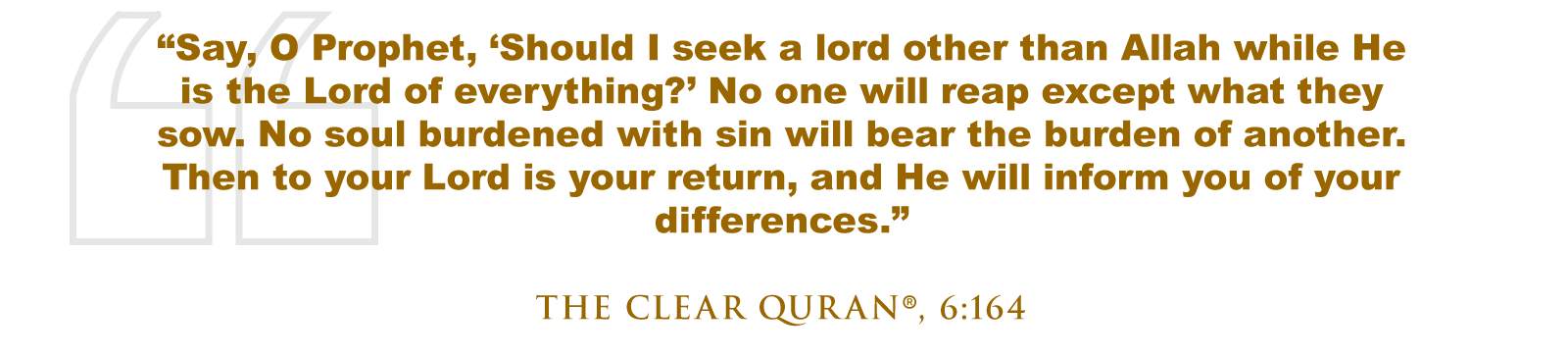
This foundational verse is repeated in multiple places in The Quran to emphasize that every individual is accountable for their own intentions, choices, and actions. The justice of Allah (SWT), as explained by great scholars, does not permit arbitrary punishment or guilt by association. This principle has a powerful psychological and spiritual impact. This cultivates personal responsibility while also freeing the believer from despair over the faults of others (family, society, or state). However, it is also clear that this personal moral autonomy does not mean that one lives in a moral vacuum, untouched by the wrongdoing around them.
Collective accountability within The Quran
While The Quran affirms that no one bears another’s sin unjustly, it also provides powerful warnings about the consequences of communal inaction, cultural normalization of sin, and collective deviation from the path of truth. When sin is no longer isolated, but instead becomes an accepted or celebrated part of a society’s moral fabric, the divine response may shift from individual to collective judgment. Allah (SWT) says, “Beware of a trial that will not only affect the wrongdoers among you. And know that Allah is severe in punishment.” (The Clear Quran®, 8:25)
This verse, revealed in the context of communal struggle and unity, serves as a warning that social corruption can lead to widespread consequences, even for those who did not directly commit the sin but allowed it to take root without challenge or reform. Ibn Kathir, in his Tafsir, explains that this verse is a stern warning that when people tolerate evil without attempting to change it, whether out of fear, complacency, or desire for approval, they may all be afflicted with a calamity that does not distinguish between the wrongdoer and the silent bystander.
The Prophet (SAW) reinforces this concept with striking clarity in the famous hadith recorded in Sunan at-Tirmidhi, “When the people see an evil and they do not change it, Allah may send upon them a punishment that encompasses all of them.” (Sunan at-Tirmidhi)
This hadith highlights a powerful dynamic, and that is that silence in the face of evil can be a form of moral participation, and thus invites divine accountability. In other words, being passive in the face of public wrongdoing can blur the lines between innocence and guilt.
The fall of nations because of collective punishment
The Quran narrates the stories of past civilizations not as historical records alone, but as moral parables for the Ummah of our Prophet Muhammad (SAW). From the people of Prophet Nuh (AS), to ‘Ad, Thamud, Madyan, and the people of Prophet Lut (AS), we are repeatedly shown how entire communities were destroyed not solely because every individual was corrupt, but because the society as a whole had reached a critical threshold of collective moral failure. Allah (SWT) says regarding the people of Prophet Lut (AS), “We poured upon them a rain of brimstone. See what was the end of the wicked!” (The Clear Quran®, 7:84)
Even if there were some in those societies who did not partake in the sin, their failure to oppose it publicly or separate themselves morally from the wrongdoing rendered them susceptible to the same worldly consequences. The classical Mufassirun often note that divine punishment did not descend until the sin had become open, systemic, and unopposed. This notion is further emphasized in the dua of Prophet Shu’ayb (AS) when he said, “O my people! Do not let your opposition to me lead you to a fate similar to that of the people of Nuh, or Hud, or Saleh. And the people of Lut are not far from you.” (The Clear Quran®, 11:89)
Prophet Shu’ayb (AS) warns not only against individual disbelief, but also against becoming a society that tolerates injustice and immorality as a norm, which becomes the real path to collective destruction.
The role of public sin and moral visibility in Islamic ethics
Islam differentiates between private sin, which remains between the individual and Allah (SWT), and public sin, which impacts society, influences others, and corrodes shared moral norms. The Prophet (SAW) said, “All of my Ummah will be forgiven except those who publicize their sins…” (Sahih Bukhari)

Public sin is not merely about visibility, it represents a normalization of vice, which, when left unchallenged, becomes a silent curriculum for the next generation. This is where society begins to share in the burden that when immorality becomes so widespread that it is no longer viewed as immoral, but rather as harmless, necessary, or even virtuous.
Thus, from an Islamic standpoint, a society becomes culpable when:
- It celebrates or justifies disobedience to Allah (SWT).
- It silences or marginalizes voices calling to truth.
- It legislates or institutionalizes falsehood or oppression.
- It discourages repentance or mocks sincere religiosity.
The Prophet (SAW) described this condition metaphorically in a hadith, “The example of those who uphold the limits set by Allah and those who transgress them is like a people who drew lots for places on a boat… if those on the upper deck allow them to [make a hole], they will all be destroyed. But if they stop them, they will all be saved.” (Sahih Bukhari)
This hadith beautifully illustrates that a society’s moral survival depends on collective accountability, not only to avoid sin, but to intervene where sin threatens communal wellbeing.
The role of scholars and thought leaders—are they guardians or gatekeepers?
In every era, the scholars, imams, teachers, and spiritual leaders of the Muslim community serve as the moral compass of the Ummah. Their voices shape public discourse, preserve the integrity of divine revelation, and challenge moral drift when it arises. When these voices are strong, sincere, and rooted in knowledge and mercy, they shield the community from collective decline. However, if scholars become silent in the face of public sin, or worse, if they enable it by offering legal or rhetorical justification for clear moral violations, the entire society is left spiritually exposed.
The Prophet (SAW) warned of this dynamic in a profound narration, “When the Children of Israel fell into sin, their scholars forbade them, but they did not desist. They sat and ate with them, and joined them in their gatherings. So Allah caused their hearts to become alike…” (Sunan Abi Dawud)
This hadith serves as a cautionary tale that the degeneration of a society is often preceded by the retreat of its scholars from enjoining good and forbidding wrong. While wisdom, strategy, and context are essential in preaching truth, silence in the face of moral erosion contributes directly to collective guilt. The role of scholars is not merely to teach, but to lovingly warn, guide, and correct, with sincerity, patience, and unwavering devotion to the truth.
Psychological and spiritual implications and why this matters today
Understanding collective sin is not only about theology, it speaks deeply to the emotional and spiritual health of a community. In a world where moral confusion is widespread, and where silence is often seen as virtue for the sake of “tolerance,” believers may begin to feel overwhelmed, either by guilt for things they didn’t do, or despair over the society they live in. Islam provides a balanced middle ground while we are not held accountable for sins we do not commit or support, we are accountable if we fail to oppose wrongdoing when we are able to do so. Allah (SWT) does not burden the soul beyond its capacity, but He does expect the heart to remain morally awake.
The Prophet (SAW) said, “Whoever among you sees an evil, let him change it with his hand. If he is not able, then with his tongue. If he is not able, then with his heart—and that is the weakest of faith.” (Sahih Muslim)
This layered model of moral resistance shows that even passive rejection of wrongdoing, within one’s heart, is a form of accountability. It means that no believer is powerless, even in a corrupt society, one can preserve taqwa, speak truth, and influence change, however small.
Hope amidst decline—can collective redemption be achieved?
Despite the seriousness of collective sin and the divine warnings associated with it, Islam is never without the door of hope, reform, and renewal. The Quran makes it clear that if even a minority within a corrupt society sincerely works to restore goodness, the collective can be spared from divine wrath and even blessed with revival. “And your Lord O Prophet would never destroy a society unjustly while its people were acting rightly.” (The Clear Quran®, 11:117)
What saves a people is not perfection, but the presence of reformers, those who speak the truth, uphold justice, and invite others back to Allah (SWT). It is through sincere repentance, collective prayer, and moral activism that societies may change their destiny. The Prophet (SAW) said, “If a people commit sins and they have the ability to change them but do not, Allah may punish them all before they die.” (Musnad Ahmad)
But he also said, “Whoever calls to guidance will have a reward like that of those who follow him, without that detracting from their reward in the slightest.” (Sahih Muslim)
Those who stand for truth are not just preserving their own salvation, they may be the reason their society is saved.
To answer the central question, yes, Islam teaches that a society can indeed be held collectively accountable, not merely for isolated sins, but when the moral conscience of the community at large decays into complacency, acceptance, or participation. This accountability is not always in the form of divine punishment in this world, but it manifests in social fragmentation, loss of blessings, spiritual emptiness, and eventual collapse of justice and unity. Yet, the solution lies within reach. The Quran and Sunnah constantly emphasize that even a minority of reformers, callers to good, and rejecters of evil can protect a society from collective destruction.
“If only there had been among the destroyed peoples before you, O believers, virtuous individuals who forbade corruption in the land—other than the few We had saved from the torment. But the wrongdoers only pursued their worldly pleasures, becoming wicked.” (The Clear Quran®, 11:116)
The challenge, then, is not to achieve perfection, but to resist normalization of sin; not to fear the actions of the wicked, but to fear the silence of the righteous.
Dua
O Allah! We seek refuge in You from the heedlessness of hearts and the weakness of faith. We ask You to make us among those who fear You in private and in public, who stand for truth without fearing the blame of the blamers.
O Allah! Do not make us among the heedless, and do not hold us accountable for the sins of others. Do not make us partners in a sin we did not commit, but remained silent about, or contributed to unknowingly.
O Allah! Make us among those who remain upright when others are corrupt, who see clearly when others are blind, who remember You when others forget, and who become a light when darkness spreads across the earth.
Ameen!