
Views: 312 min read
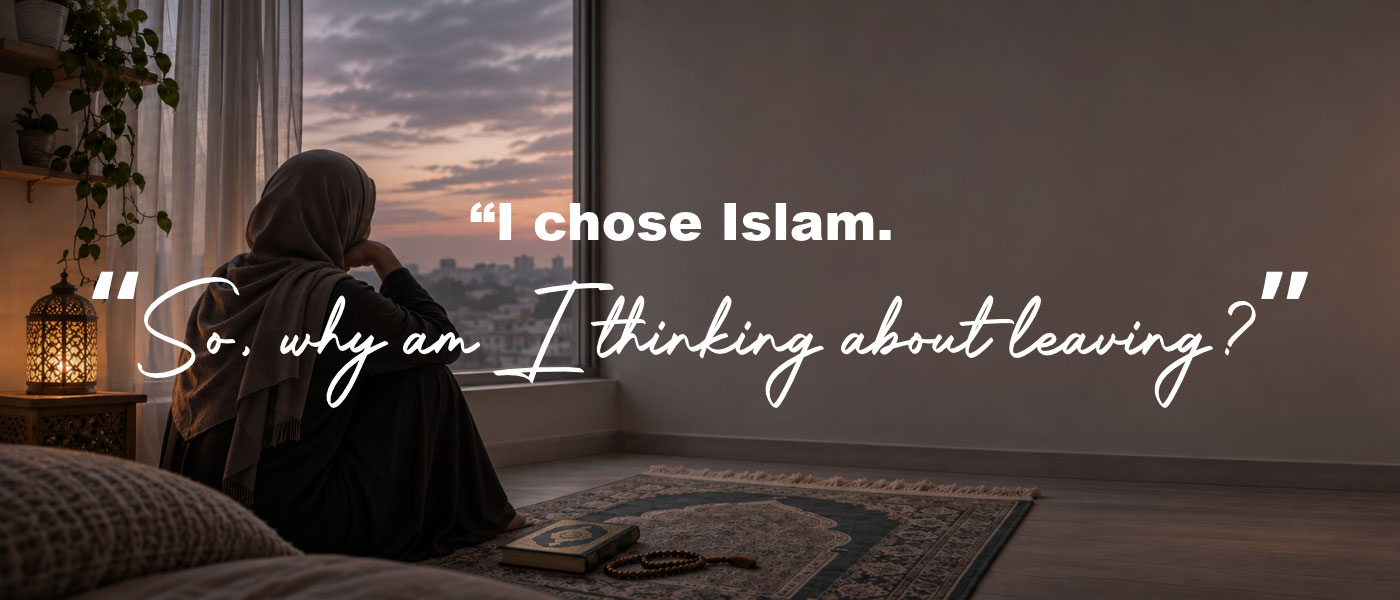
When you first embraced Islam, perhaps you felt a sense of peace that was difficult to put into words. You had spent weeks, months, or even years learning about the religion, asking questions, and searching for something that finally made sense to you. Reciting the Shahadah, the declaration of faith, marked the beginning of a new chapter in your life. You were eager to learn how to pray, understand The Quran, and become the kind of Muslim you had envisioned yourself being. At the time, you might never have imagined that the religion you had chosen so willingly would one day become something you were questioning. Yet here you are, perhaps months or years after your conversion, wondering whether you made the right decision.
The prayers that once brought you comfort may now feel like an obligation you struggle to fulfill. You may feel disconnected from the Muslim community, overwhelmed by religious expectations, or troubled by questions about Islam that nobody seems willing to answer. Perhaps your family still hasn’t accepted your conversion, or you’ve begun to miss aspects of the life you lived before becoming Muslim. Whatever the circumstances, you may have found yourself thinking something you never expected to think—I want to leave Islam, but I don’t know if I should.
Admitting this can be frightening, particularly when you remember how certain you once felt about your decision. You may worry that questioning Islam makes you a hypocrite, that Allah (SWT) is displeased with you, or that other Muslims will judge you if they discover how you feel. You might even be struggling to distinguish between a genuine loss of religious conviction and the exhaustion of trying to live up to expectations that seem impossible to meet. Before deciding what these feelings mean for your future, it is worth examining where they are coming from. There is a considerable difference between no longer believing in Islam, struggling to practice it, and feeling hurt by the circumstances surrounding your conversion. Each deserves to be taken seriously, and understanding which one you are experiencing may help you approach your decision with greater clarity.

The part of becoming Muslim that nobody prepared you for
For many converts, embracing Islam is an intensely personal decision, but living as a Muslim introduces changes that extend far beyond personal belief. Your relationship with food, clothing, friendships, family, and daily routines may change almost overnight. Even ordinary experiences, such as eating at a restaurant or spending the holidays with relatives, can become complicated in ways you never anticipated. Meanwhile, you are learning an unfamiliar religious vocabulary, trying to understand centuries of Islamic scholarship, and adjusting to acts of worship that many Muslims have practiced since childhood. There may also be an unexpected emotional adjustment.
Before converting, you could explore Islam at your own pace, choosing which books to read and which questions to investigate. After converting, you might encounter people who expect you to understand religious obligations immediately or after conflicting opinions about how you should live. The freedom and excitement of discovering Islam can gradually give way to the pressure of doing everything correctly, leaving you wondering why practicing your chosen religion feels so much harder than learning about it.
Research suggests that these difficulties deserve considerably more attention from Muslim communities. In January 2025, Yaqeen Institute for Islamic Research published Becoming Muslim: The Lives of American Converts to Islam, drawing on survey responses from 618 American converts. Although the survey was not designed to represent every convert in the United States, the report explored challenges involving family relationships, religious doubts, cultural inclusion, and the availability of meaningful community support. Importantly, it emphasized the need for mosques and Islamic organizations to provide sustained care after conversion rather than concentrating their attention primarily on the moment someone declares their faith.
This highlights an uncomfortable reality that a person can receive tremendous encouragement when embracing Islam and still feel remarkably isolated afterward. A community may celebrate a Shahadah without recognizing how much guidance, patience, and friendship a new Muslim will need in the months and years that follow. If this has been your experience, it is worth acknowledging that your difficulties may reflect a lack of support rather than a failure on your part to understand or appreciate Islam.
Does questioning Islam mean you have lost your faith?
When people begin questioning their religion, they sometimes assume that the existence of doubt means their faith has already disappeared. However, religious uncertainty can take different forms. You might believe in Allah (SWT) while struggling to understand a particular teaching, or accept the message of The Quran while finding it difficult to reconcile an experience of suffering with your understanding of divine mercy. You may also have questions about the existence of God, the prophethood of Prophet Muhammad (SAW), or whether The Quran is truly divine revelation. These are serious questions, but experiencing uncertainty about them is not necessarily the same as having reached a settled conclusion.
The Quran itself contains an extraordinary conversation involving Prophet Ibrahim (as), whose devotion to Allah (SWT) is central to Islamic tradition. In Surah Al-Baqarah, verse 260, Prophet Ibrahim (as) asks Allah (SWT) to show him how He (SWT) brings the dead back to life. When Allah (SWT) asks whether he believes, Prophet Ibrahim (as) replies that he does, but wishes for his heart to be reassured. What makes this account particularly meaningful is that Prophet Ibrahim’s (as) desire for reassurance is recorded in The Quran rather than concealed as something shameful. His question emerges from a wish to deepen his understanding of something he already believes. This does not mean every religious doubt is identical to Prophet Ibrahim’s (as) question, nor does it suggest that every theological difficulty has an easy answer. It does, however, demonstrate that wanting greater understanding and reassurance is not inherently incompatible with religious conviction. Sometimes a person believes something intellectually, but struggles to feel confident in it emotionally. At other times, the uncertainty concerns the belief itself and requires careful examination. Recognizing the difference is important because neither situation is helped by pretending the question does not exist.
There is another illuminating account in Sahih Muslim involving the companion Hanzala, who became deeply concerned about the inconsistency of his spiritual state. When he was in the Prophet’s (SAW) company, he felt intensely aware of the Hereafter, but when he returned home to his family and daily responsibilities, that awareness diminished. He became so distressed by the change that he feared he was being hypocritical. After listening to his concerns, the Prophet (SAW) explained that people have times for worship and times for worldly affairs. Rather than demanding that Hanzala maintain the same intensity of religious feeling at every moment, he (SAW) recognized the changing circumstances of ordinary human life (Sahih Muslim)
For a new Muslim, this distinction matters, The enthusiasm you experienced immediately after conversion may not remain at the same intensity forever. There may be days when you are eager to pray and read The Quran, and others when worship feels difficult or your attention is elsewhere. Spiritual fluctuation does not, by itself, tell you whether Islam is true or false. It may simply mean that the emotional experience of practicing a religion is changing as it becomes part of your everyday life.
When the Muslims around you make you question Islam
One of the most painful experiences for a convert can be discovering that the Muslim community does not always reflect the values that initially attracted them to Islam. Perhaps you were inspired by the religion’s teachings about compassion, justice, generosity, and human dignity, only to encounter judgment, exclusion, or insensitivity from people who claim to uphold those principles. You may have visited a mosque hoping to build friendships but found yourself sitting alone while everyone else gathered with people they already knew. You might have received unwelcome comments about your clothing, cultural background, level of religious knowledge, or how quickly you have adjusted to practicing Islam. For converts who have already experienced tension with their families, these encounters can be especially damaging. You may have sacrificed a considerable amount to embrace Islam, only to discover that the community you hoped you would support does not seem particularly interested in getting to know you beyond your conversion story. What should have been a source of encouragement can become another source of rejection, leaving you to wonder whether the life you left behind was more welcoming than the one you have entered.
Islamic teachings provide grounds for examining such behavior critically. In Surah Al-Hujurat, verse 13, Allah (SWT) reminds humanity that people were created from different peoples and tribes so that they may know one another, and that righteousness, rather than ancestry or social standing, is the measure of a person’s worth in His book. A convert who cannot speak Arabic fluently, did not grow up observing Ramadan, or comes from a different ethnic background is not religiously inferior simply because these experiences are unfamiliar to them. At the same time, distinguishing Islam from the behavior of Muslims should not become a way of dismissing genuine harm. If you have experienced discrimination, manipulation, humiliation, or abuse within a religious environment, those experiences deserve to be addressed rather than explained away. You have every reason to establish boundaries, seek help, or distance yourself from individuals and institutions that have mistreated you. Religious commitment does not require accepting harmful behavior simply because they possess religious knowledge or occupy respected positions within a community.
If your experience with Muslims has made you question Islam, it may help to examine the teachings that initially interested you separately from the conduct of the people you have encountered. This does not guarantee that every concern will disappear, and it should not be used to excuse those responsible for your treatment. It simply allows you to consider whether your disappointment is directed at the religion’s principles, the people presenting those principles, or both.
What if practicing Islam feels too difficult?
Imagine learning to pray five times a day while working full-time, attending school, or raising children. You are still memorizing Arabic recitations, adjusting your schedule around prayer times, learning the difference between obligatory and recommended acts of worship, and trying to understand what is permissible in everyday life. During Ramadan, you may be fasting for the first time without anyone in your household sharing the experience. On top of these responsibilities, you might be receiving a constant stream of advice about what you should be doing differently. It is understandable that such a significant adjustment can become exhausting, particularly if you are measuring your progress against Muslims who have had decades to develop their knowledge and routines. The problem is compounded when advice is delivered without regard for your circumstances, making religious practice feel like an endless examination in which every mistake is evidence that you are failing.
The Prophet Muhammad (SAW) warned against approaching religious practice in an excessively burdensome manner. In Sahih Bukhari, he (SAW) taught that religion is easy and cautioned that those who overburden themselves in religious matters will be overcome by them. His guidance encouraged a balanced, sustainable approach to worship rather than one characterized by unnecessary hardship. This teaching does not erase Islam’s religious obligations, nor does it mean that every difficult requirement can simply be disregarded. Rather, it is a reminder that learning and practicing those obligations should be accompanied by sound knowledge, appropriate guidance, and an understanding of one’s circumstances. A new Muslim should be helped to distinguish what is required from what is recommended, which practices belong to Islamic teachings, and which expectations may be rooted primarily in local custom.
If you are overwhelmed by the number of things you are expected to learn, begin by identifying what you genuinely need help understanding. Perhaps you need someone to patiently teach you how to perform salah, clarify the rules of purification, or explain how particular obligations apply to your circumstances. You do not need to become an expert in Islamic jurisprudence before you can begin practicing your religion meaningfully. Nor should you be made to feel embarrassed about asking questions that someone raised in a Muslim household might consider elementary. Above all, remember that religious knowledge is acquired over time. Difficulty with an act of worship does not automatically mean you reject its purpose, and struggling to fulfill an obligation does not make every effort you have already made meaningless.
What if there are things about Islam you genuinely disagree with?
Not every person considering leaving Islam is struggling because of loneliness, personal hardship, or the demands of religious practice. Some are troubled by questions about Islamic theology, history, morality, or law. You may have encountered discussions about women’s rights, marriage, religious freedom, punishment, the authenticity of hadith, or particular passages of The Quran that seem difficult to reconcile with your understanding of justice. Perhaps you have read competing interpretations of an Islamic teaching and do not know which one to trust. These concerns deserve more than a hurried reassurance that you simply need to have stronger faith. If you are struggling with a particular teaching, it is reasonable to understand its textual basis, historical context, and the ways scholars have interpreted it. Some disagreements involve misconceptions that can be addressed through further learning. Others concern substantial theological or ethical questions over which scholars have developed different positions. Still others involve teachings on which Islamic traditions are relatively consistent, even if the conclusions remain difficult for you to accept.
A meaningful conversation about these subjects should acknowledge the difficulty rather than pretend it does not exist. The person you approach for guidance should be willing to explain their reasoning, distinguish between established teachings and disputed interpretations, and acknowledge the limits of their own knowledge. It is also reasonable to consult more than one qualified scholar when examining a complex issue, particularly when the question involves different schools of Islamic jurisprudence or interpretations of scripture. The Quran repeatedly encourages reflection, and in Surah An-Nahl, verse 43, it directs those who lack knowledge to consult people who possess it. In its immediate context, the verse addresses a question about earlier messengers, but it also illustrates the importance of seeking informed guidance when facing questions outside one’s expertise.
Do not feel pressured to claim that an explanation has satisfied you when it has not. You can appreciate someone’s effort to answer your question while still needing further clarification. Equally, encountering an interpretation you find troubling does not necessarily mean you have exhausted everything Islamic scholarship has to say about the subject. Careful inquiry requires patience, reliable sources, and a willingness to examine evidence rather than accepting or rejecting conclusions solely because they are comforting.

So, should you leave Islam?
This is ultimately a question about what you believe to be true, and it deserves more consideration than a single difficult week, a disappointing encounter at the mosque, or an argument with someone who has made you feel unwelcome. Islam is a religion built around convictions about Allah (SWT), revelation, prophethood, worship, and the purpose of human existence. If you are contemplating leaving it, understanding what you believe about those foundations is more useful than focusing exclusively on whether being Muslim currently feels easy or difficult. Begin by being specific about what has changed:
Do you no longer believe that Allah (SWT) exists?
Do you believe in Him but feel distant from Him?
Have you concluded that The Quran is not divine revelation?
Are you struggling to understand certain passages?
Do you want to leave because your beliefs have changed?
Do you feel that continuing to practice under your present circumstances feels emotionally exhausting?
You may find it helpful to write down the questions that are troubling you and examine them individually. Return to the reasons you originally embraced Islam, not because your previous convictions must determine your present conclusions, but because remembering what persuaded you can help you assess whether those reasons still hold. Read The Quran with a reliable translation and commentary, investigate the questions that have genuinely unsettled you, and seek discussion with someone knowledgeable enough to address them without resorting to shame or threats.
Remember, there is no need to force yourself to make a public declaration about your beliefs while you are still trying to understand them. You may need time, privacy, and appropriate guidance to decide what you genuinely think. If people around you have responded aggressively to your questions, protecting your personal safety and choosing carefully whom you confide in are sensible precautions. If you still believe in Allah (SWT) and wish to remain Muslim but feel unable to manage everything expected of you, then perhaps the immediate issue is not whether you should leave Islam. It may be how to obtain the support, education, and healthier religious environment you need. If, on the other hand, you are struggling with the fundamental claims of Islam, those questions deserve careful intellectual examination rather than being reduced to a problem of motivation or religious discipline.
Here are six practical ways to reconnect with Islam when your faith feels weak
If you still believe in Allah (SWT) but feel disconnected from Islam, you may be wondering what you can actually do to rebuild your relationship with your faith. The answer does not necessarily involve making dramatic changes to your lifestyle or expecting yourself to become the devoted Muslim you remember being immediately after your conversion. Sometimes, reconnecting with Islam requires reconsidering how you approach your religion, recognizing what has been affecting your spiritual well-being, and making room for experiences that remind you why your faith once mattered so deeply.
Here are six practical steps worth considering:
Introduce dhikr into your everyday routine.
Learn about Allah (SWT) through His beautiful names.
Create a dedicated space for worship at home (if it is safe to do so).
Spend time reflecting on Allah’s (SWT) creation.
Establish a meaningful Friday routine.
Participate in an Islamic learning experience outside your usual routine.
These steps will not necessarily resolve every doubt you have about Islam, and they should not be treated as substitutes for investigating genuine questions about your beliefs. However, if you still wish to practice Islam, they offer concrete ways to strengthen your religious routine, experience different forms of worship, and develop a more informed relationship with Allah (SWT).
Dua
رَبَّنَا لَا تُزِغْ قُلُوبَنَا بَعْدَ إِذْ هَدَيْتَنَا وَهَبْ لَنَا مِن لَّدُنكَ رَحْمَةً ۚ إِنَّكَ أَنتَ ٱلْوَهَّابُ
˹They say,˺ “Our Lord! Do not let our hearts deviate after you have guided us. Grant us Your mercy. You are indeed the Giver ˹of all bounties˺.’” (The Clear Quran®, 3:8)
Ameen, ya Rabb!