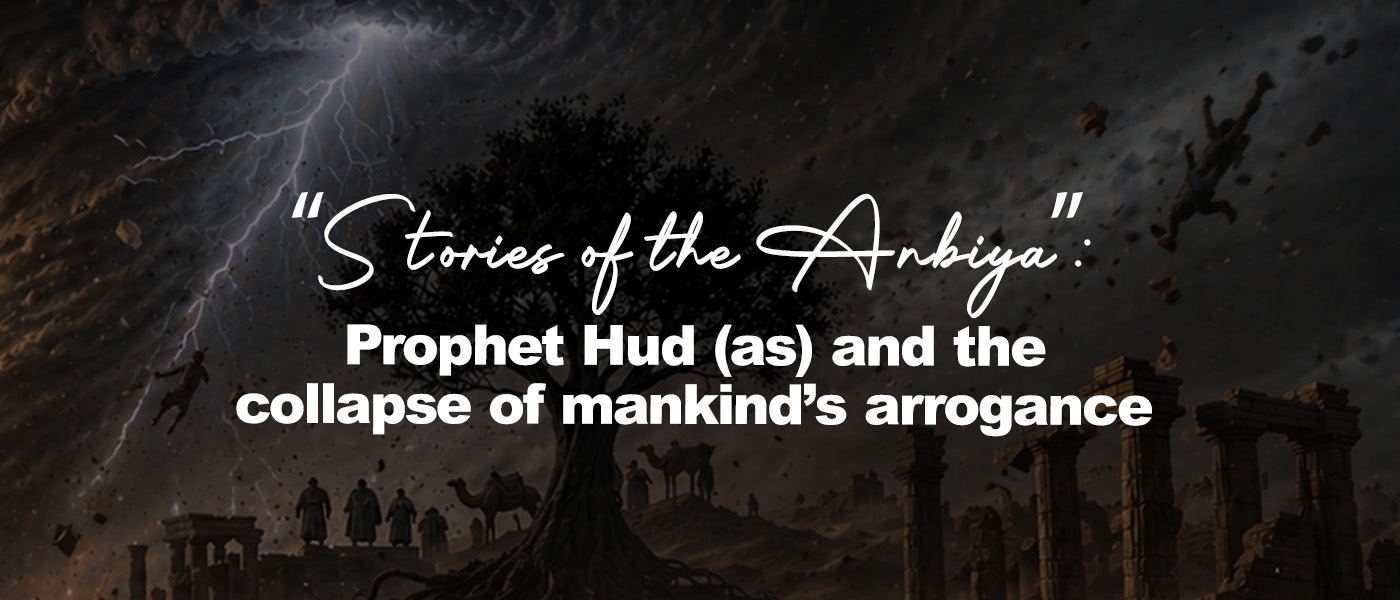
Stories of the Anbiya is a new series exploring the lives of the prophets mentioned in The Quran. Through these narratives, we aim to uncover not only the historical journeys of the prophets but also the timeless truths they reveal about the human soul, the struggle for justice, and the meaning of faith in a fractured world. This series is an invitation to revisit these lives with fresh eyes, and to see their stories echoed in our own.
Among the prophets mentioned in The Quran, Prophet Hud (as) stands as one of the clearest examples of a messenger sent to powerful people who believed their strength made them untouchable. His story unfolds in a society that had mastered physical construction, territorial control, and visible world dominance, yet beneath that outward power lay a dangerous moral blindness. The people to whom he was sent, the nation of ‘Ad, were not a weak or struggling civilization. They were known for their extraordinary physical stature, their towering structures, and their confidence in what they had built. In many ways, they represented a society convinced that material strength was enough to secure permanence. It is precisely in such an environment that Prophet Hud (as) emerges, because revelation often arrives where human arrogance begins to confuse power with permanence. The Quran presents Prophet Hud (as) not simply as a preacher calling people away from idol worship, but as a figure confronting a deeper spiritual illness, and that was the belief that prosperity itself proves independence from Allah (SWT).
His people had inherited strength, resources, and influence, and over time these blessings became the very reason they resisted correction. Their buildings rose high, but humility had diminished. Their land reflected engineering and order, yet inwardly they had lost the ability to recognize that every form of power remains fragile before divine command. Prophet Hud (as) therefore speaks to them with a message that is both theological and moral, repeatedly reminding them that what they possess is not self-created nor protected from consequence.
Allah (SWT) records his call with striking clarity, “And to the people of ‘Ad We sent their brother Hud. He said, ‘O my people! Worship Allah—you have no other god except Him. Will you not then fear Him?” (The Clear Quran®, 7:65) This was a similar call made by Prophet Nuh (as) to his people. Like many prophets, Prophet Hud (as) was not sent as an outsider unfamiliar with those he addressed. He belonged to them, knew their habits, understood their pride, and spoke from within their world. This makes their rejection more revealing, because they were not dismissing a stranger, but someone whose integrity they already knew. What makes Prophet Hud’s (as) story especially powerful is that his people did not reject him because they lacked evidence of his sincerity.
Rather, they rejected him because his message threatened the assumptions that sustained their pride. The Quran repeatedly shows that societies often resist prophets most when they feel strongest because strength can create the illusion that correction is unnecessary. For this reason, the story of Prophet Hud (as) remains deeply relevant across generations. It is not only about an ancient people destroyed by wind, but about what happens when human beings begin to believe that visible success removes the need for moral accountability. To study Prophet Hud (as) is therefore to study how revelation confronts arrogance before collapse arrives.
His life teaches that civilizations do not fall only when they lose resources, they also decline when they lose the ability to hear the truth while still powerful. In that sense, his message reaches beyond history. It becomes a permanent warning that no structure, no influence, and no inherited strength can stand when gratitude disappears and pride begins to speak louder than obedience.
Who were the people of ‘Ad?
Before the warning of Prophet Hud (as) could be understood, it is necessary to understand the kind of people to whom he was sent because The Quran does not present ‘Ad as an ordinary nation. They are described as a people whose worldly power had become exceptional, so much so that strength itself became part of their identity. They lived in southern Arabia, and classical Islamic scholarship often links them to the region of al-Ahqaf, an area associated with vast sand dunes and long stretches of land where settlements once stood. The Quran refers to this directly when it says, “And remember the brother ‘Ad, when he warned his people, who inhabited the sand-hills—there were certainly warners before and after him—˹saying, “Worship- none but Allah. I truly fear for you the torment of a tremendous day.” (The Clear Quran®, 46:21) This geographic reference is important because it situates their story not in abstraction, but in a real landscape where traces of lost civilizations became part of moral memory.
What distinguished ‘Ad was not merely that they possessed land, but that they transformed it into a visible statement of dominance. Allah (SWT) describes them in Surah Al-Fajr when He (SWT) says, “Did you not see how your Lord dealt with ‘Ad—˹the people˺ of Iram—with ˹their˺ great stature, unmatched in any other land […].” (The Clear Quran®, 89:6-8) The phrase immediately suggests a people whose built environment carried unusual scale and ambition. Scholars have long understood this as an indication of extraordinary structures whether through architecture, columns, fortified spaces, or monumental construction that caused them to be remembered for physical grandeur. Their civilization impressed not only themselves, but became an example preserved in revelation because of how rare their worldly stature had become.
Yet alongside this physical greatness came a dangerous transformation of character. Strength slowly turned into self-exaltation. The Quran records their attitude through the question they repeated openly, “As for ‘Ad, they acted arrogantly throughout the land with no right, boasting, ‘Who is superior to us in might?’ Did they not see that Allah ˹Himself˺, Who created them, was far superior to them in might? Still they persisted in denying Our signs.” (The Clear Quran®, 41:15) This was not simply confidence, it was a worldview in which human ability became detached from dependence upon Allah (SWT). Their bodies were described in narrations as powerful, their presence commanding, and their society highly conscious of visible superiority. Over time, they no longer treated strength as a blessing entrusted by Allah (SWT), but as proof that they stood beyond vulnerability. This is why their story becomes more than an account of ancient architecture or tribal power. It becomes a lesson in how civilizations begin to collapse inwardly long before collapse becomes visible outwardly.
What makes ‘Ad especially significant is that they came after the people of Prophet Nuh (as). In other words, they inherited a world that already carried the memory of divine punishment, yet even historical precedent did not produce humility. Generations had passed, material life had expanded again, and with prosperity came forgetfulness. Prophet Hud (as) was therefore sent to a people who were not ignorant of human history, but who had become convinced that previous destruction belonged only to others, never to themselves. This remains one of the deepest patterns in Quranic history that societies often study the downfall of others while quietly assuming their own circumstances are fundamentally different. For this reason, the people of ‘Ad were not condemned because they built strongly, nor because they possessed power. The crisis was that power had entered the heart in the form of arrogance. Their structures became symbols of excess, their strength became language of superiority, and gratitude slowly gave way to defiance. It is exactly here that Prophet Hud (as) begins speaking more directly, because revelation often arrives when strength stops producing humility and begins producing denial.

How Prophet Hud (as) confronted their arrogance
Once the character of the people of ‘Ad is understood, the force of Prophet Hud’s (as) message becomes clearer because he was not speaking to a people who lacked intelligence or social order. He was addressing a civilization that had become impressed by itself. Their strength was visible in the way they built, the way they occupied land, and the way they spoke about themselves. For this reason, Prophet Hud (as) did not begin by attacking their power itself, but by exposing the emptiness that had entered the way they understood it. He repeatedly reminded them that what they possessed was not self-generated, and that physical greatness without obedience carries no protection before Allah (SWT). The Quran records one of his strongest criticisms through a question that directly targeted how they used their abilities.
Allah (SWT) said in The Quran, “˹Why˺ do you build a landmark on every high place in vanity […].” (The Clear Quran®, 26:128) Here, revelation reveals that part of their problem was not simply destruction, but the mindset behind it. Their building had become tied to display, permanence, and a subtle illusion that what they established could somehow secure lasting control. The Quran presents this not as innocent prosperity, but as a sign that worldly expansion had begun to detach them from the reality of mortality. They built as though permanence could be engineered. Prophet Hud (as) then moved beyond architecture and addressed conduct itself, “[…] and act so viciously when you attack ˹others˺?” (The Clear Quran®, 26: 130) This short phrase reveals that arrogance had already shaped how they treated others. Strength was no longer neutral, it had become harshness. A society that believes itself superior often begins to lose restraint because power without moral accountability easily turns severe. His message therefore challenged both belief and behavior. He was calling them not only away from false worship, but away from a way of living that assumed dominance justified excess.
What is striking is that Prophet Hud (as) also reminded them repeatedly of the source of everything they enjoyed. He said, in meaning, that Allah (SWT) had increased them in strength and provided them with livestock, gardens, and springs. In other words, He deliberately redirected their attention to gratitude. This is a recurring prophetic method that before warning of punishment, prophets first remind them what they have already received. The logic is clear that if blessings are recognized properly, arrogance becomes harder to sustain. However, if blessings are treated as personal entitlement, warning begins to feel offensive rather than merciful. Their response, however, showed how deeply pride had settled. Instead of reflecting, they answered with dismissal. “They responded, ‘It is all the same to us whether you warn ˹us˺ or not.’” (The Clear Quran®, 26:136)
This is one of the most revealing statements in their story because it shows not loud rebellion alone, but a kind of emotional indifference to haq. They had heard him, understood that he opposed their way, yet chose to behave as though warning itself carried no weight. The danger of arrogance is not always anger, sometimes it is the quiet conviction that correction is unnecessary. They also accused him of foolishness saying in effect that they saw him as lacking judgment. This accusation appears repeatedly in prophetic history. When prophets challenged dominant norms, those attached to such norms often recast moral clarity as irrationality. Prophet Hud (as), however, answered with calm dignity. He denied foolishness and described himself simply as a trustworthy messenger from the Lord of all worlds. He did not answer with insults. He returned the conversation to trust, revelation, and accountability.
This becomes one of the strongest lessons from his dawah because he was speaking to people whose pride had already shaped their hearing. Yet even then, his language remained measured, direct, and persistent. He understood that arrogance often resists truth first before collapse forces recognition later, and that is exactly where the next stage of the story begins.
The drought, the cloud they welcomed, and the wind that destroyed ‘Ad
After repeated warnings, the confrontation between Prophet Hud (as) and his people entered a stage where rejection was no longer expressed only through argument. The Quran shows that once a people persist in arrogance despite clear warning, the consequences often begin subtly, through changes in the conditions they once assumed would always remain stable. For ‘Ad, one of the earliest signs came through deprivation itself. The natural ease they were accustomed to began to weaken. Classical tafsir explains that drought affected them, rain was withheld, and the comfort of their environment began to change. For a people whose strength was tied not only to physical ability but to the resources around them, this should have been a moment for reflection. Instead, even difficulty did not immediately soften their certainty. Prophet Hud (as) had already urged them to seek forgiveness and return to Allah (SWT), making clear that repentance itself opens the door to restored mercy. The Quran records him saying, in meaning, that if they sought forgiveness, Allah (SWT) would send abundant rain and add strength to their strength. This is significant because his warning was never detached from hope. Even after mockery and rejection, he still presented repentance as a real possibility. Prophetic warning in The Quran is never simply a threat, it always carries an open path back before punishment arrives. Yet their response remained unchanged because they continued to treat his words as exaggeration rather than urgent truth.
Then came the moment that appeared, outwardly, to answer their immediate need. A cloud appeared on the horizon. In a dry land, after hardship, a cloud naturally suggested relief. The Quran captures their reaction with remarkable precision. Allah (SWT) says, “Then when they saw the torment as a ˹dense˺ cloud approaching their valleys, they said ˹happily˺, ‘This is a cloud bringing us rain.’ ˹But Hûd replied,˺ ‘No, it is what you sought to hasten: a ˹fierce˺ wind carrying a painful punishment!’” (The Clear Quran®, 46:24) The very thing they thought would restore them carried their destruction instead. The punishment of ‘Ad did not come through fire or flood like other nations, but through wind, and this was no ordinary wind. The Quran describes it as violent, continuous, and commanded entirely by Allah (SWT). In another passage, it is called a furious wind unleashed for several nights and days without interruption, striking everything by divine order until what had once looked powerful became motionless remains.
The imagery is especially striking because the punishment directly confronted the illusion that defined them. People known for physical strength were overcome by something invisible. Towers, bodies, and visible force could not resist air once Allah (SWT) commanded it to carry destruction. This is one of the deepest theological lessons in their story that human beings often trust what appears materially strong yet divine power repeatedly demonstrates that what cannot even be grasped by the hand may become the means by which entire civilizations fall. The Quran describes the aftermath with severe imagery, saying they became like hollow trunks of uprooted palm trees. “[…] which Allah unleashed on them non-stop for seven nights and eight days, so that you would have seen its people lying dead like trunks of uprooted palm trees.” (The Clear Quran®, 69:7)
Their physical stature, once a source of pride, is remembered in the language of collapse. What had stood tall now lay emptied. Their civilization, once impressive enough to inspire confidence in permanence, became a lesson preserved precisely because permanence had been assumed. Through all of this, Prophet Hud (as) and those who believed with him were saved by Allah’s (SWT) mercy. The Quran repeatedly preserves this prophetic pattern that punishment never arrives blindly, and distinction is always made between persistent denial and those who held faith. In the case of ‘Ad, what remained after destruction was not their structures, but their lesson that strength without humility can vanish faster than those who possess it imagine.
Dua
O’ Allah (SWT)! Protect our hearts from the kind of pride that blinds a person to truth even when it stands clearly before them. Do not allow the blessings You have given us to become a cause of heedlessness, and do not let strength, comfort, or worldly ease distance us from gratitude to You.
O’ Allah (SWT)! Grant us hearts that remain humble before You, tongues that speak truth with dignity, and patience when obedience becomes difficult.
Save us from becoming attached to what is temporary, and make us people who remember that true safety lies only in nearness to You.
Ameen, ya Rabb!