Stories of the Anbiya is a new series exploring the lives of the prophets mentioned in The Quran. Through these narratives, we aim to uncover not only the historical journeys of the prophets but also the timeless truths they reveal about the human soul, the struggle for justice, and the meaning of faith in a fractured world. This series is an invitation to revisit these lives with fresh eyes, and to see their stories echoed in our own.
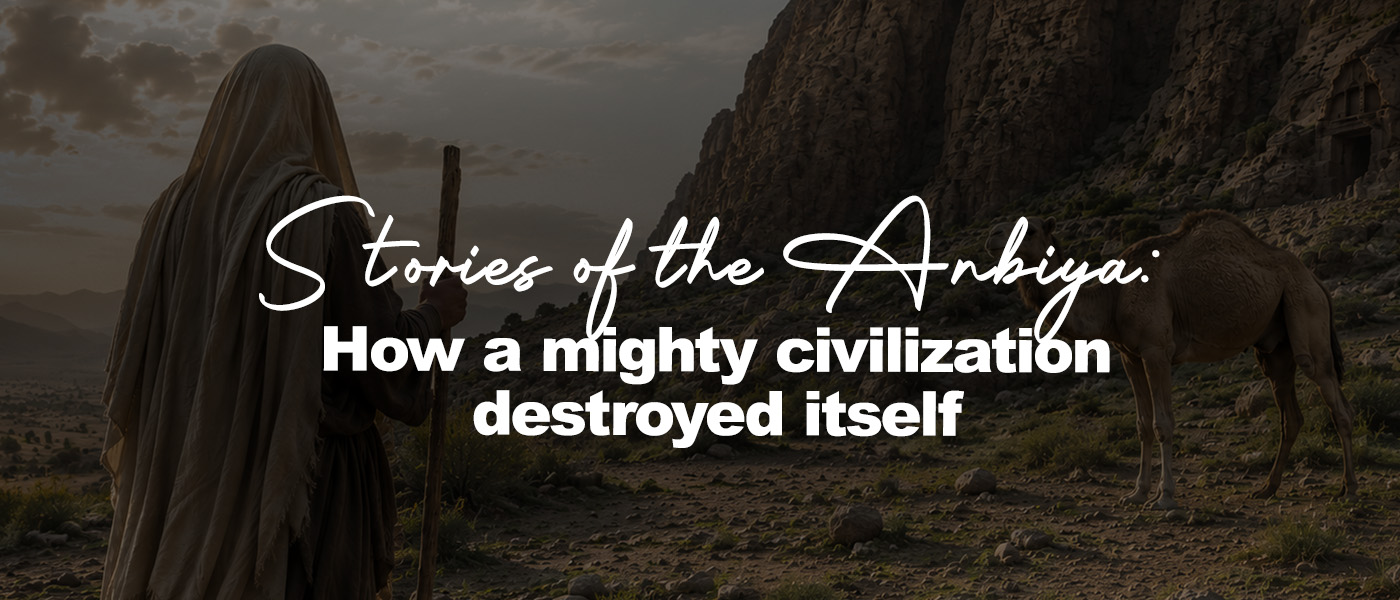
History is filled with powerful nations that believed their strength would last forever. They built magnificent cities, accumulated wealth, mastered their environment, and imagined that nothing could bring them down. Yet time and time again, those same civilizations vanished, leaving behind little more than ruins and cautionary tales. Among the most striking examples of this reality is the nation of Thamud, the people to whom Prophet Saleh (as) was sent. The people of Thamud were not poor, weak, or struggling. They were among the most advanced societies of their time. Blessed with fertile lands and remarkable engineering skills, they carved entire homes into mountains and transformed rocky landscapes into thriving communities. To an outside observer, they appeared untouchable. Their prosperity seemed permanent, and their achievements appeared to guarantee their future. However, beneath this image of success was a growing spiritual crisis.
As their wealth increased, their gratitude decreased. As their accomplishments expanded, their dependance upon Allah (SWT) diminished. The blessings that should have brought them closer to their Creator instead became sources of pride and arrogance. What began as prosperity gradually evolved into heedlessness, and what began as confidence eventually became defiance. Out of His mercy, Allah (SWT) did not leave them without guidance. He sent them one of their own, Prophet Saleh (as), a man known for his wisdom, integrity, and sincerity. His mission was simple, and that was to remind his people of the One who had granted them everything they possessed before it was too late. Yet the story of Prophet Saleh (as) is unlike many others in one remarkable way. His people did not merely reject a prophet’s words, they were given a miracle so clear and extraordinary that it left little room for doubt. When they demanded proof, Allah (SWT) answered their challenge with a sign that became one of the most famous miracles mentioned in The Quran, and that was the she-camel of Prophet Saleh (as).
What followed was not merely a conflict between belief and disbelief. It was a test of humility, gratitude, and obedience. The fate of an entire civilization would ultimately hinge upon how they responded to a miracle they themselves had requested. The story of Prophet Saleh (as) is therefore more than an account of an ancient nation. It is a reminder that material success cannot replace faith, that miracles do not benefit hearts unwilling to submit, and that every blessing carries with it a responsibility. Through his life and mission, we are invited to reflect on our own relationship with Allah (SWT), our response to His signs, and the dangers of following worldly success to blind us to eternal truths.
The nation that came after ‘Ad
The story of Prophet Saleh (as) cannot be fully understood without first understanding the people to whom he was sent to guide. The nation of Thamud emerged after the destruction of another powerful civilization known as the people of ‘Ad, who had rejected the message of Prophet Hud (as). Their downfall should have served as a warning to future generations, but history often demonstrates how quickly human beings forget the lessons of those who came before them. Allah (SWT) reminds the people of Thamud of this reality through the words of Prophet Saleh (as) when He said, “Remember when He made you successors after ’Âd and established you in the land—˹and˺ you built palaces on its plains and carved homes into mountains. So remember Allah’s favours, and do not go about spreading corruption in the land.” (The Clear Quran®, 7:74) The phrase “successors after ‘Ad” is significant to reflect upon. It highlights that the people of Thamud inherited opportunities that others had lost. They were given a chance to build a society that would learn from the mistakes of previous nations rather than repeat them.
This pattern appears throughout human history. One generation rises while another falls. Kingdoms replace kingdoms. Civilizations inherit the achievements and warnings of those who came before them. The wise learn from the past, while the arrogant assume they are different. The people of Thamud gradually began to view themselves as masters of their own destiny. Surrounded by the achievements of their civilization, they became less concerned with spiritual accountability and more focused on preserving their worldly status. Their idols occupied places of reverence, and many began directing acts of devotion toward objects that possessed neither power nor authority. What makes this particularly tragic is that traces of earlier prophetic guidance still existed among them. The message of Tawheed had not completely disappeared. Rather, it had become diluted over time through customs, traditions, and false beliefs that accumulated across generations.
This is often how spiritual decline occurs. Entire societies rarely abandon truth overnight. Instead, deviations emerge gradually until practices that once seemed foreign become normalized and accepted. As this decline continued, Allah (SWT) chose a man from among their own people to restore what had been forgotten. Unlike kings who sought authority or tribal leaders who sought influence, this man would carry a far greater responsibility, and that is the responsibility of prophethood.
Why was Prophet Saleh (as) the chosen one?
Whenever Allah (SWT) sends a messenger to a people, that messenger is not chosen at random. The prophets were selected from among the very communities they would later call to faith. They understood the language, customs, concerns, and mindset of their people better than anyone else. Prophet Saleh (as) was no exception. Before receiving revelation, Prophet Saleh (as) was already known among Thamud as a man of sound judgment and noble character. He had earned the respect of his community, and many viewed him as someone with a promising future. His honesty and wisdom made him a trusted figure, someone whose words carried weight among the people. This is why the reaction of Thamud was initially one of surprise rather than outright hostility. The Quran records them saying, “They argued, “O Ṣâliḥ! We truly had high hopes in you before this. How dare you forbid us to worship what our forefathers had worshipped? We are certainly in alarming doubt about what you are inviting us to.” (The Clear Quran®, 11:62) Their statement reveals an important reality, and that is that they did not question his integrity. They did not accuse him of dishonesty. Instead, they were bewildered that someone they respected would challenge beliefs that had been passed down through generations.
For many people, inherited traditions can become so deeply rooted that questioning them feels uncomfortable, and even threatening. The people of Thamud were not merely attached to idols made of stone, they were attached to a way of life. Accepting the message of Prophet Saleh (as) would require them to reexamine assumptions that had shaped their society for years. Yet prophets are not sent to preserve falsehood simply because it is familiar. Prophet Saleh (as) began calling his people to the same message preached by every prophet before him, and that was worship to Allah (SWT) alone, and abandon all forms of shirk.
Allah (SWT) said in The Quran, “And to the people of Thamûd We sent their brother Ṣâliḥ. He said, ‘O my people! Worship Allah—you have no other god except Him. A clear proof has come to you from your Lord: this is Allah’s she-camel as a sign to you. So leave her to graze ˹freely˺ on Allah’s land and do not harm her, or else you will be overcome by a painful punishment.’” (The Clear Quran®, 7:73) Notice the compassion in his words. He addressed them as “O my people,” emphasizing his concern for them rather than any desire for superiority over them. He was not speaking as an enemy or an outsider. He was speaking as someone who sincerely wanted the best for his community. His mission was not limited to correcting their beliefs. He also called them to reform their conduct. A society’s spiritual condition and moral condition are often intertwined. When people lose their connection with Allah (SWT), injustice and corruption inevitably begin to spread. Prophet Saleh (as) therefore urged them to recognize the blessings they had been given and to use them responsibly.
For a time, he continued this invitation patiently. Some individuals listened, and others remained hesitant. However, among the powerful leaders of Thamud, resistance was beginning to grow. What started as skepticism would soon develop into opposition.
The growing resistance to His message
As Prophet Saleh (as) continued calling his people to the worship of Allah (SWT), the reactions among Thamud became increasingly divided. While some individuals recognized the truthfulness of his message and chose to believe, many others remained unwilling to change. The strongest opposition came not from the common people, but from those who held influence within society. Throughout history, the wealthy and powerful have often viewed prophetic reform as a threat. The message of the prophets reminds people that true authority belongs to Allah (SWT), that every individual is accountable for their actions, and that worldly status does not determine a person’s worth. For those accustomed to privilege and control, such teachings can feel unsettling. The Quran highlights this dynamic when describing the leaders of Thamud. Allah (SWT) says, “The arrogant chiefs of his people asked the lowly who believed among them, ‘Are you certain that Ṣâliḥ has been sent by his Lord?’ They replied, ‘We certainly believe in what he has been sent with.’” (The Clear Quran®, 7:75) This exchange reveals an important contrast. Those whom society looked down upon were often the first to recognize the truth, while many of the elite dismissed it. The believers were judged by their faith, whereas the arrogant judged others according to status and social standing.
Rather than engaging sincerely with the message of Prophet Saleh (as), the leaders became increasingly focused on preserving their authority. They feared the social changes that genuine faith would bring. If people accepted that Allah (SWT) alone deserved worship and obedience, the influence of those who benefited from the existing religious system would begin to diminish. As a result, mockery and criticism became common. The opponents of Prophet Saleh (as) demanded proof that he was truly a messenger from Allah (SWT). In their minds, his words alone were not enough. They wanted something extraordinary, something that would satisfy their demands and remove any possibility of doubt. Yet their request was not motivated by a sincere search for guidance. Deep down, many of them had already decided to reject whatever evidence was presented. They were not seeking the truth, they were setting conditions for belief according to their own desires. Still, Allah (SWT), in His wisdom and mercy, would grant them the sign they demanded. What followed would become one of the most remarkable miracles mentioned in The Quran and one of the defining moments in the story of Prophet Saleh (as).
The miracle they asked for
As opposition to Prophet Saleh (as) intensified, the people of Thamud began demanding a sign that would prove he had truly been sent down by Allah (SWT). Like many nations before them, they claimed they would believe if only they were shown something extraordinary. Their challenge was not vague. According to the classical tafsir literature, they specified the miracle they wanted to see. Before them stood a massive rock formation, and they demanded that Prophet Saleh (as) produce from it a living she-camel. It was a request so extraordinary that they believed it would expose him if he was lying. For years, they had heard his warnings. They had listened to his call toward Tawheed. Now they wanted evidence according to their own conditions. Allah (SWT), however, is fully capable of all things. In The Quran it says, “And O my people! This she-camel of Allah is a sign for you. So leave her to graze ˹freely˺ on Allah’s earth and do her no harm, or a swift punishment will overtake you!” (The Clear Quran®, 11:64)
The miracle appeared exactly as they had requested. What moments earlier had been an ordinary rock formation now became the source of an unmistakable sign from Allah (SWT). Before their eyes stood a living creature whose existence defied all natural expectations. The significance of this miracle extended far beyond its unusual nature. The people of Thamud had specifically asked for a sign, and Allah (SWT) answered them with one. Any claim that they lacked evidence could no longer be made. Any excuse that they had not been shown proof was removed. This is an important theme throughout the stories of the prophets. Often, people claim that they would believe if only they witnessed a miracle. Yet The Quran repeatedly demonstrates that faith is not merely a matter of seeing extraordinary events. A person must also possess the humility to accept what those signs point toward.
Many among Thamud were astonished by what they witnessed. Some who had previously hesitated found their faith strengthened. Others recognized that Prophet Saleh (as) had spoken the truth all along. Yet there remained those whose pride prevented them from accepting what stood plainly before them. Rather than allowing the miracle to soften their hearts, they began searching for ways to dismiss it, avoid its implications, or simply carry on with their lives as though nothing had changed. The sign had appeared, the evidence had been given, and now came the test.
The test of the she-camel
The appearance of the she-camel marked a turning point in the mission of Prophet Saleh (as). The people of Thamud had demanded a miracle, and Allah (SWT) had given them one. However, divine signs are rarely sent for spectacle alone. They carry responsibilities, and they often reveal what lies hidden within the hearts of those who witness them. After the she-camel appeared, Allah (SWT) established clear instructions regarding her treatment. She was to be left unharmed and allowed to graze freely throughout the land. More importantly, she was given a designated share of the community’s water supply. Allah (SWT) says, “And tell them that the ˹drinking˺ water must be divided between them ˹and her˺, each taking a turn to drink ˹every other day˺.”” (The Clear Quran@, 54:28) At first glance, the command may seem simple. The people were not being asked to surrender their wealth, abandon their homes, or endure hardship. They were merely required to respect the sign that Allah (SWT) had placed among them and honor the arrangement He had decreed.
Yet history shows that the greatest tests are not always the most difficult ones. Often, the real challenge lies in whether a person is willing to obey Allah (SWT) when His command conflicts with their pride, habits, or desires. For the believers among Thamud, the she-camel served as a daily reminder of Allah’s (SWT) power and mercy. Every time they saw her, they were reminded that their Lord had responded directly to their people’s demand for proof. Her presence strengthened their conviction and reinforced the truthfulness of Prophet Saleh’s (as) message. For others, however, the she-camel became a source of resentment. Her designated access to water was viewed by some as an inconvenience. What had begun as a miraculous sign gradually became, in their eyes, an unwelcome disruption to their routines. Rather than reflecting on the miracle itself, they focused on how it affected them personally. This reveals an important reality about human nature. Sometimes people ask Allah (SWT) for guidance, but when guidance arrives, they dislike the responsibilities that come with it. They desire the sign but reject the commitment it requires. As days turned into weeks and weeks into months, the frustration among the opponents of Prophet Saleh (as) continued to grow. The she-camel remained a visible reminder that they had been proven wrong. Every moment she lived among them was another testimony to the truth they were trying to ignore.
Eventually, what began as irritation would transform into something far more dangerous. A small group of influential individuals would decide that the only way to silence the sign was to remove it altogether.
The conspiracy against the sign of Allah (SWT)
Not every member of Thamud participated in the growing hostility toward the she-camel. Many continued to live their lives, while the believers remained steadfast alongside Prophet Saleh (as). Yet among the most arrogant members of society, frustration was beginning to turn into something more organized. The Quran draws attention to a group of individuals who became central figures in the corruption of the nation. Allah (SWT) says, “And there were in the city nine ˹elite˺ men who spread corruption in the land, never doing what is right.” (The Clear Quran®, 27:48) These were not ordinary troublemakers. They were influential figures whose decisions carried weight among the people. Instead of using their position to guide others toward truth, they used their influence to oppose it.
The presence of the she-camel constantly undermined their efforts. It stood as a living reminder that Prophet Saleh (as) had brought a genuine sign from Allah (SWT). As long as she remained among them, the truth remained visible. For people whose hearts had already rejected faith, this became intolerable. Rather than questioning their own beliefs, they began discussing how to eliminate the source of their discomfort. Their issue was no longer with the message alone, it was now with the sign itself. This is a pattern that appears repeatedly throughout history. When people refuse to accept the truth, they often attempt to remove the reminders of it. Instead of addressing the evidence, they attack the messenger, the symbol, or the source that exposes their error.
The leaders of Thamud gradually convinced themselves that if the she-camel disappeared, the challenge posed by Prophet Saleh (as) would disappear as well. What they failed to understand was that the she-camel was never the true issue. The real issue was the cognition of their hearts. A miracle can guide a sincere person toward faith, but it cannot force faith upon someone determined to reject it. The people of Thamud had already witnessed the sign, and they had already received the warning. They had already given every opportunity to reflect and repent. Now, they stood at a crossroads. They could humble themselves before Allah (SWT), acknowledge the truth, and save themselves from destruction. Or, they could allow arrogance to push them toward an act from which there would be no return. Tragically, they chose the latter. Their next action would become one of the most infamous acts of defiance recorded in prophetic history, and that was the killing of the she-camel.
Prophet Saleh’s (as) final warning to his people
The killing of the she-camel marked a point of no return for the people of Thamud. For years, Prophet Saleh (as) had called them toward the worship of Allah (SWT), reminding them of the blessings they had been given and warning them against arrogance and disbelief. He had spoken to them with patience, sincerity, and compassion, never seeking anything from them except that they return to their Creator. Yet despite witnessing a miracle with their own eyes, they chose rebellion over repentance. The slaughter of the she-camel was not merely an act of disobedience, it was a public declaration that they had no intention of submitting to the command of Allah (SWT). Even then, Allah’s (SWT) mercy was not immediately withdrawn. Through Prophet Saleh (as), the people were given one final warning.
Allah (SWT) says, “But they killed her, so he warned ˹them˺, ‘You have ˹only˺ three ˹more˺ days to enjoy life in your homes—this is an unfailing promise!’” (The Clear Quran®, 11:65) These three days were among the greatest manifestations of divine mercy in the story. The punishment was announced before it arrived, giving the people an opportunity to reflect upon their actions and seek forgiveness. Rather than being struck down instantly, they were granted time to reconsider the path they had chosen. Yet the hearts of many had become so hardened that even this final warning failed to move them toward repentance. The Quran also tells us that the corruption of Thamud had reached such a level that a group of influential men began plotting against Prophet Saleh (as) himself. Having rejected his message and destroyed the miraculous sign sent by Allah (SWT), they now sought to eliminate the messenger.
Allah (SWT) says in The Quran, “They vowed, ‘Let us swear by Allah that we will take him and his family down by night. Then we will certainly say to his ˹closest˺ heirs, ‘We did not witness the murder of his family. We are definitely telling the truth.’” And ˹so˺ they made a plan, but We too made a plan, while they were unaware.” (The Clear Quran®, 27:49-50). Their scheme reflected the depth of their arrogance. Instead of recognizing their wrongdoing, they believed that silencing Prophet Saleh (as) would somehow free them from accountability. However, no plan can succeed against the decree of Allah (SWT). While the disbelievers continued plotting, Prophet Saleh (as) prepared to depart with those who had believed in his message. He had fulfilled his duty completely. He had conveyed the truth, demonstrated patience in the face of rejection, and warned his people of what was to come. The believers left alongside him, placing their trust in Allah (SWT), while the rest of Thamud remained behind, confident that nothing would happen to them.
They had spent years dismissing the warnings of their prophet, and now they treated even the final countdown as something to mock. Yet with each passing day, the promise of Allah (SWT) drew closer, and the mighty nation that once believed itself untouchable stood on the brink of destruction.
The destruction of the people of Thamud
When the three days came to an end, the promise of Allah (SWT) was fulfilled exactly as Prophet Saleh (as) had warned. The people of Thamud had been given every opportunity to believe. They had received a messenger from among themselves, witnessed a miracle with their own eyes, and were even granted a final period to repent after committing their great crime. Yet they chose arrogance over humility and defiance over submission. As a result, the punishment that they had mocked for so long finally descended upon them. The Quran describes their destruction through several powerful descriptions, each highlighting the suddenness and severity of what occurred. Allah (SWT) says in The Quran, “Your Lord will certainly judge between them by His justice, for He is the Almighty, All-Knowing.” (The Clear Quran®, 7:78) In another verse, Allah (SWT) says, “And the ˹mighty˺ blast overtook the wrongdoers, so they fell lifeless in their homes […].” (The Clear Quran®, 11:67) The nation that had once prided itself on its strength was brought to an end in a single moment. Their carved dwellings, their wealth, and their worldly achievements could not protect them from the decree of their Lord.
One of the most striking aspects of this punishment is how completely it shattered the illusion of self-sufficiency that had consumed Thamud. For years, they had trusted in their power, their numbers, and the security of their mountain homes. They believed they had mastered their environment and secured their future. Yet when the command of Allah (SWT) came, none of these things benefited them in the slightest. The very homes they had carved into the rock became their final resting places. Allah (SWT) says, “[…] as if they had never lived there. Surely Thamûd denied their Lord, so away with Thamûd!” (The Clear Quran®, 11:68) In a matter of moments, a civilization that had taken generations to build became a lesson for all who would come after it.
The destruction of Thamud is not preserved in The Quran merely as a historical event. It is a reminder that no society is immune from accountability before Allah (SWT). Wealth, technology, influence, and power may create the appearance of permanence, but every blessing ultimately remains under the control of its Creator. The people of Thamud believed their greatness would protect them, yet their story became proof that true security lies not in worldly strength, but in faith, gratitude, and obedience to Allah (SWT).
Prophet Saleh’s (as) farewell to his people
After the punishment had passed and the nation of Thamud lay destroyed, Prophet Saleh (as) addressed his people one final time. The Quran preserves his words as a powerful testimony to the sincerity of every prophet who has ever been sent by Allah (SWT). Allah (SWT) says in The Quran, “So he turned away from them, saying, ‘O my people! Surely I conveyed to you my Lord’s message and gave you ˹sincere˺ advice, but you do not like ˹sincere˺ advisors.’” (The Clear Quran®, 7:79) These words capture the heartbreak of a prophet whose mission had been rejected despite years of patience and concern. Prophet Saleh (as) did not seek wealth, power, or recognition from his people. His only desire was to guide them toward what would benefit them in this life and the next. He warned them repeatedly, called them with wisdom, and even after they rejected him, he continued hoping that they would return to Allah (SWT). Yet in the end, they chose to ignore every opportunity they were given.
The story of Thamud did not end with their destruction. Allah (SWT) preserved their account in The Quran so that future generations could reflect upon it and avoid repeating their mistakes. Even today, the remnants of ancient dwellings carved into rock stand as a reminder of a people who once believed their achievements would last forever. Their ruins are not merely archaeological sites; they are signs that worldly power, no matter how impressive, cannot protect a nation that turns away from its Creator. What remains of Thamud is not their wealth or influence, but the lesson of their rise and fall. During the lifetime of Prophet Muhammad (SAW), these ruins were still known to the Arabs. As he and his companions passed through the area associated with Thamud during the expedition to Tabuk, he instructed them not to enter the dwellings of those who had been punished except in a state of reflection and humility.
In an authentic narration he said, “Do not enter upon these people who were punished unless you are weeping. If you cannot weep, then do not enter upon them, lest what afflicted them afflict you.” (Sahih al-Bukhari). This guidance teaches us that the stories of destroyed nations are not meant for entertainment or curiosity alone. They are meant to inspire self-reflection, gratitude, and a renewed commitment to obedience to Allah (SWT). The legacy of Prophet Saleh (as) therefore extends far beyond his own generation. His story serves as a reminder that Allah (SWT) continually sends guidance to humanity, but guidance only benefits those who are willing to accept it. The people of Thamud had every opportunity to believe, yet they allowed pride to stand between themselves and the truth. Through their story, we are reminded that the greatest danger is not a lack of evidence, but a heart that refuses to submit when the evidence becomes clear.
Dua
O Allah, Lord of the heavens and the earth! We ask You to make us among those who recognize Your signs and respond to them with faith and humility. Protect our hearts from arrogance, pride, and the illusion of self-sufficiency that led the people of Thamud astray.
O Allah! Grant us hearts that accept the truth when it reaches us, even when it challenges our desires, habits, or assumptions. Do not allow us to be among those who reject sincere advice or turn away from Your guidance after it has been made clear.
O Allah! As You protected Prophet Saleh (as) and the believers who stood firm alongside him, protect us and our families from trials that lead people away from Your path!
Ameen, ya Rabb!